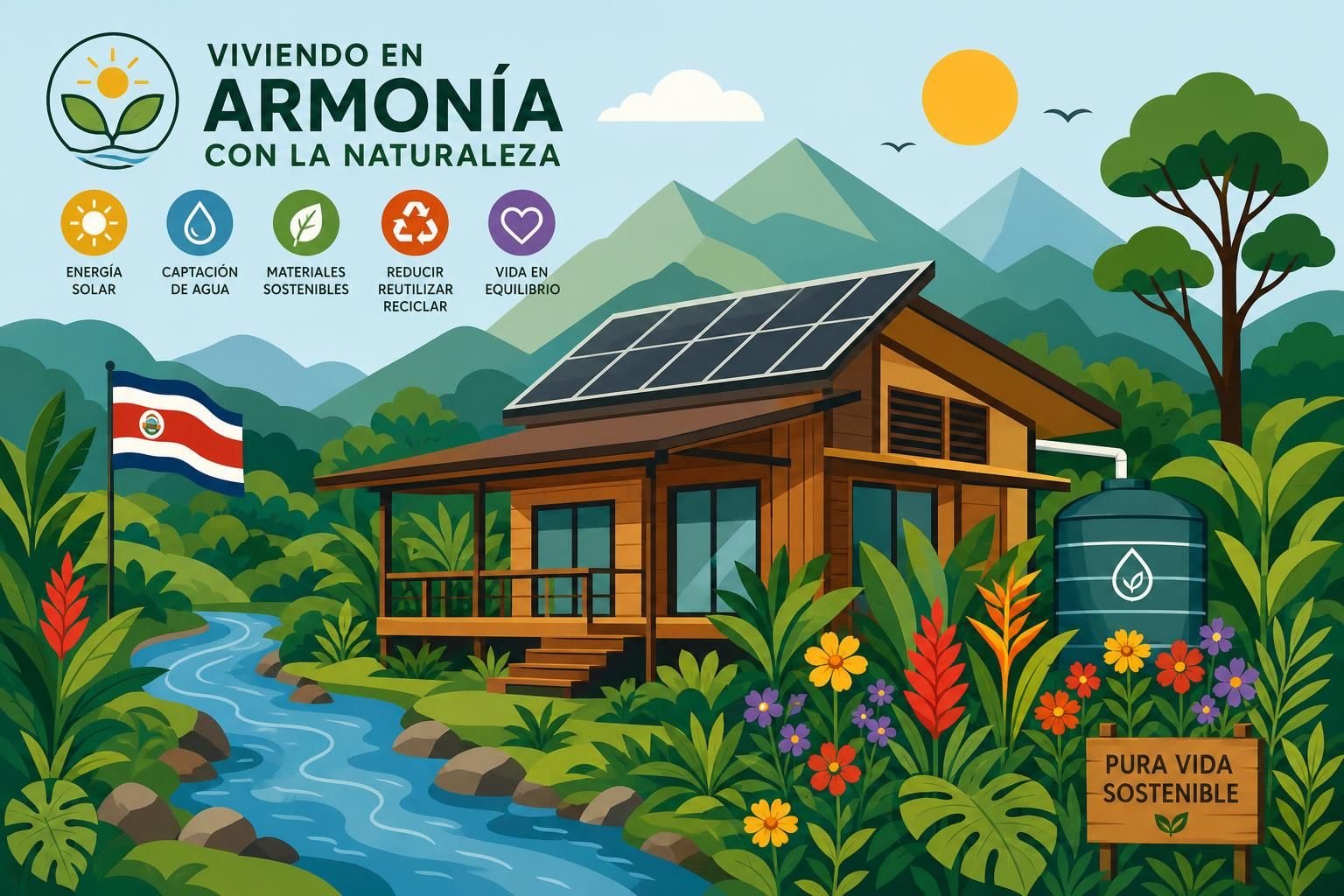
Off-grid living in Costa Rica is legal and workable. Law 10086 recognizes self-generation that is not connected to the national grid, and a solar system with batteries and a backup generator is a well-proven setup. What decides whether a property works is water and paperwork: without a water availability letter there is no building permit, and about 1 in 4 development projects that request one are now turned down (The Tico Times, August 2026).
This guide covers the rules, power, water, wastewater, internet, climate by region, land, communities and costs, with dated sources, plus lessons from Off Grid Destinations’ founders, who have lived off-grid in Costa Rica since 2012. For the background, read our founders’ own story of living off the grid in Costa Rica; this guide doesn’t repeat it.
The short version:
- Off-grid power is legal: Law 10086 defines “operación en isla,” self-generation that is not interconnected with the national grid. The house still needs a municipal building permit.
- No water availability letter from AyA or the local ASADA means no construction permit, and these letters are getting harder to obtain (details in the water section).
- A household-only well on the same property needs registration; anything beyond that, including rentals, needs a full concession from MINAE.
- On the Pacific side, size solar and batteries for the rainy months (May to October) and water storage for the dry months (December to March, plus the April transition).
- Starlink has been licensed in Costa Rica since 2023, and some eco communities have fiber, so remote work is possible on a lot of off-grid land; test it on site.
- The founders’ one piece of advice: “Do your homework, and don’t fall in love with a property before understanding its practical limitations!”
Is Off-Grid Living Legal in Costa Rica?
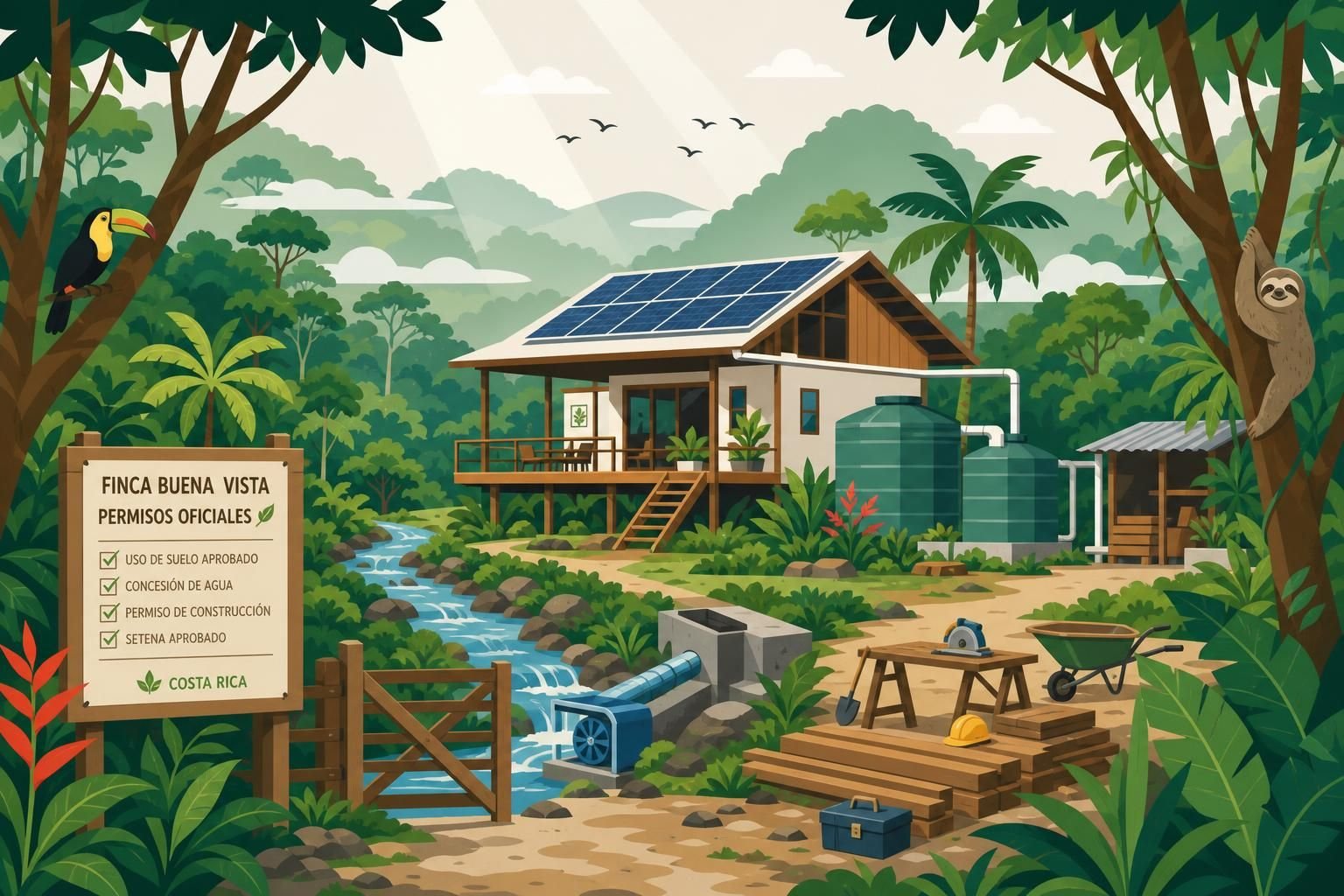
Yes. Law 10086 of December 2021, on distributed energy resources, defines “operación en isla” (island operation): self-generation that is energized but not interconnected with the national electricity system. You can power a home with solar, a small hydro system or a generator without ever connecting to the utility.
Legal power does not mean a legal house, though. Three things are still regulated:
- Building: a construction permit from the municipality, which needs a water availability letter first.
- Water: registration of a household well, or a concession from MINAE for anything beyond household use.
- Wastewater: treatment systems are approved under Decree 39887-S-MINAE.
The founders found the paperwork harder than the hardware: “Being off-grid doesn’t automatically exempt you from building regulations. You still need to consider land-use permissions, legal access, water rights and potentially environmental restrictions.” And: “The rules can vary between municipalities, and getting clear, consistent answers isn’t always straightforward.”
Who Can Own the Land
Foreigners have essentially the same ownership rights as citizens, so you can buy titled land in your own name (ECIJA, July 2026). The exception is the coast: the maritime zone covers the first 200 meters, of which the first 50 meters are public and the next 150 meters can only be held under concession.
Owning land and living in Costa Rica full time are separate questions; residency rules are covered in the costs section below. Before you buy, ask the municipality what you can build, and have a local lawyer check title, access and water.
Off-Grid Power in Costa Rica: Solar, Batteries and Hydro
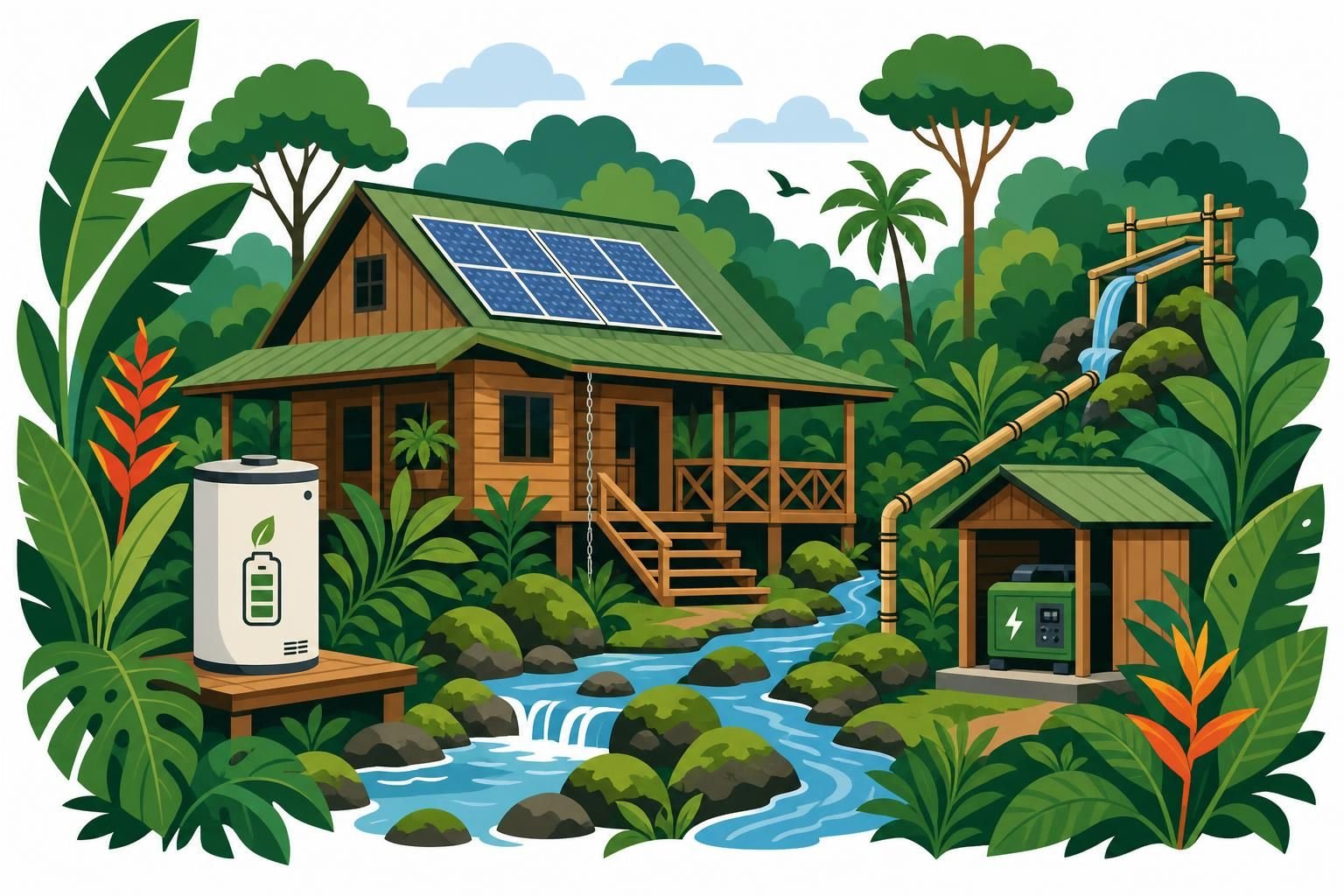
Solar panels with a battery bank and a backup generator are the standard off-grid setup, with micro-hydro as an option on land with a reliable stream and the water rights to use it. Costa Rica’s grid produced 98.6% of its electricity from renewable sources in 2025, so going off-grid here is about remoteness and independence rather than cleaner power. The grid also depends on rain: in the 2024 El Niño drought, renewable generation fell to about 86% and officials turned to rationing and more thermal backup (ICE data reported by The Tico Times, March 2026).
Solar and Batteries: Size for the Rainy Season
The founders ran their home this way: “We were completely off-grid, running entirely on solar with a generator for backup and hard charging the batteries when necessary.”
Their system, for scale: “Our original system consisted of twelve 320W Canadian Solar panels (3.84 kW total), eight Rolls S-550 deep-cycle batteries and a 3.6 kW OutBack inverter/charger.” The equipment estimates came to around $11,000 in 2016. Treat that as a reference point, not a quote; prices and battery technology have changed since.
They would change two things. “If I were doing it again, I’d definitely go with modern lithium batteries rather than lead-acid,” citing “the reduced maintenance, greater usable capacity and longer lifespan.” And: “I’d also make sure the system was designed with plenty of room for expansion. Your electricity needs tend to evolve, and having a little extra capacity is never a bad thing, especially during Costa Rica’s rainy season!”
Why the rainy season drives sizing: on the Pacific side, the dry season runs December to March, April is a transition and the rains run May to October (Visit Costa Rica). A system sized for sunny February can fall short in October. Plan it in this order:
- List every daily load (fridge, pump, lights, laptop, internet dish) and add up the kilowatt-hours.
- Ask an installer for the expected output at your site in the cloudiest months, and size the panels for that.
- Decide how many cloudy days in a row the batteries must carry, and size usable capacity to match.
- Choose lithium if the budget allows, and leave room on the roof, rack and inverter to expand.
- Set the generator’s job: the battery level or number of cloudy days at which it starts.
For more on battery types, see our guide to off-grid energy storage.
Micro-Hydro and Hybrid Systems
Many rural lots have a stream, and hydro produces power day and night. But water in Costa Rica is not simply yours to use: anything beyond household use needs a concession from MINAE’s Dirección de Agua, so plan on a concession before you count on a stream for power. Protection zones also apply around springs and along rivers, which can limit where an intake and pipe can go.
Streams also run lowest late in the dry season, when the sun is strongest, which is why solar and hydro complement each other well. Measure flow in both seasons and confirm the water rights with a lawyer before you buy equipment. Our guide to off-grid hydroelectric systems explains how small systems work.
Many people choose a hybrid instead of going fully off-grid: grid power plus home solar is the setup in several eco communities, including Alegría Village and Ecovilla San Mateo, while St. Michael’s Sustainable Community near Parrita describes solar with small hydro and biomass.
Water Off the Grid: The Make-or-Break Issue
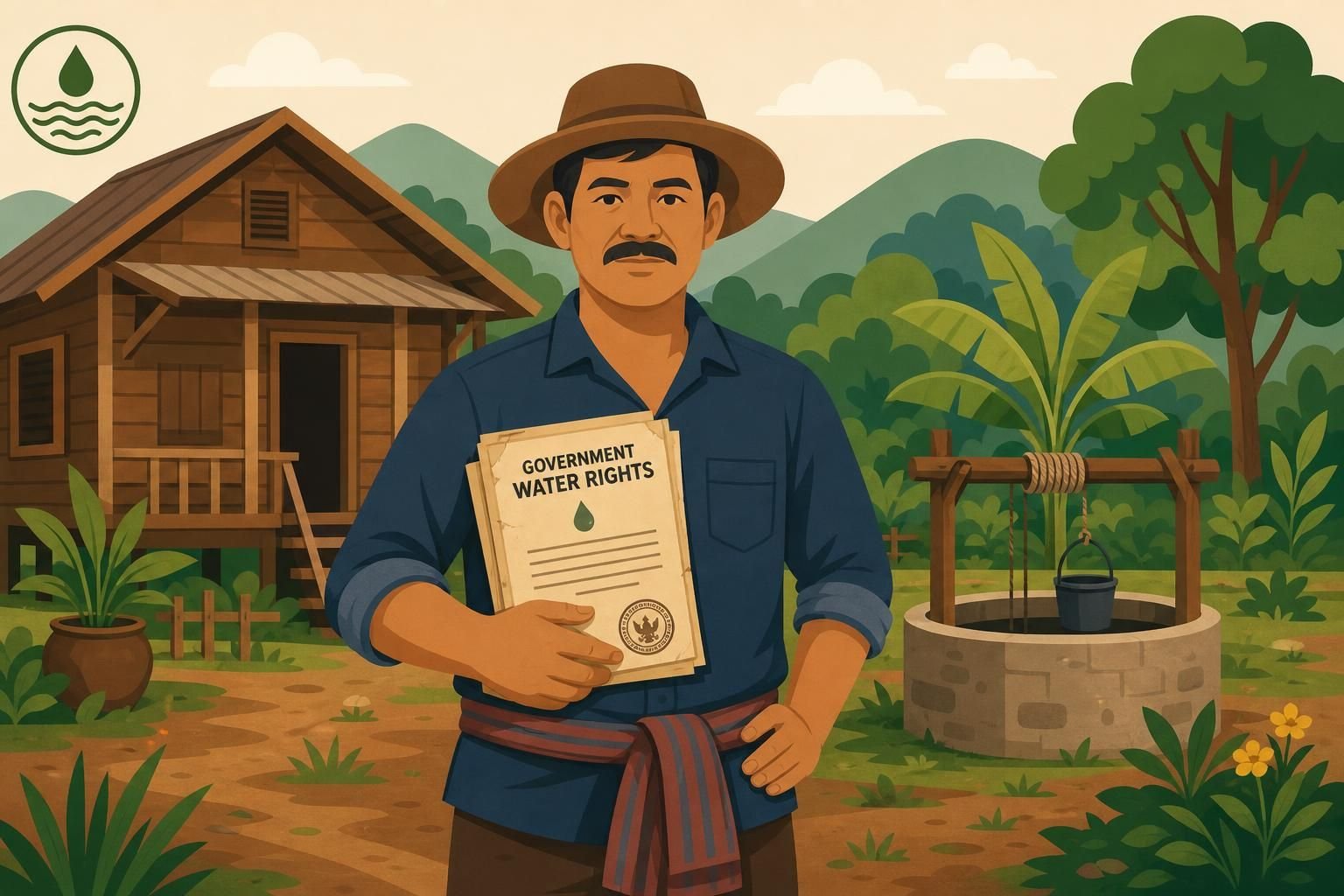
Water decides whether off-grid land works, both legally (the water letter and your water rights) and practically (whether the source still flows in March). You can buy power equipment; water you have to find, prove and protect. The founders rank it first: “Water security is probably one of the most important things to establish before committing to an off-grid property in Costa Rica.”
Water Availability Letters: No Letter, No Permit
Without a valid water availability letter from AyA or the local ASADA (community water board), the municipality will not issue a construction permit. No permit means no CFIA plan registration and no electricity meter. About 1 in 4 development projects that request a letter are now turned down, and a positive letter holds for about 12 months (The Tico Times, August 2026).
- Find out who supplies water to the lot: AyA or a local ASADA.
- Ask the seller for an existing letter and check its date and issuer.
- If there is none, request one before closing, and make the purchase conditional on a positive answer where you can.
- Move quickly once you have it: file plans and the permit while the letter is still valid.
- Ask the municipality in writing what proof of water it accepts if you plan to rely on your own well or spring.
Our guide to buying land in Costa Rica and the water letter covers this step in more detail.
Wells, Springs and Rainwater
Groundwater is national property. A well used only for the household on the same property needs registration, not a concession; anything beyond that, including rentals, needs a full concession from MINAE (The Tico Times, August 2026). If you hope to rent a guest casita one day, ask a lawyer how that changes your water rights before you buy.
The founders used a spring: “We used a gravity-fed spring water system, which was fantastic for off-grid living. One of the biggest benefits was that we didn’t need electricity to pump water, which significantly reduced our energy requirements.” Their warning: “A spring flowing beautifully in September isn’t necessarily going to perform the same way in March!” They “strongly recommend checking the year-round flow, having adequate water storage and making sure the water is properly tested and treated for drinking.”
Rainwater changes by coast. The Caribbean side has no well-defined dry season, so roof collection is steadier there. On the Pacific side, plan storage for four to five dry months. Drought years make that worse: in 2026, El Niño pushed the Pacific side and the Central Valley into drought while the Caribbean got heavy rain (The Tico Times, August 2026).
To size storage, measure your source late in the dry season, estimate what your roof can catch, subtract both from your daily use month by month, and store enough to carry the longest gap plus a drought-year buffer. A spring or well backed by rain tanks is safer than either alone. Our guide to off-grid water systems covers pumps, tanks and treatment.
Waste and Wastewater: What Needs Approval
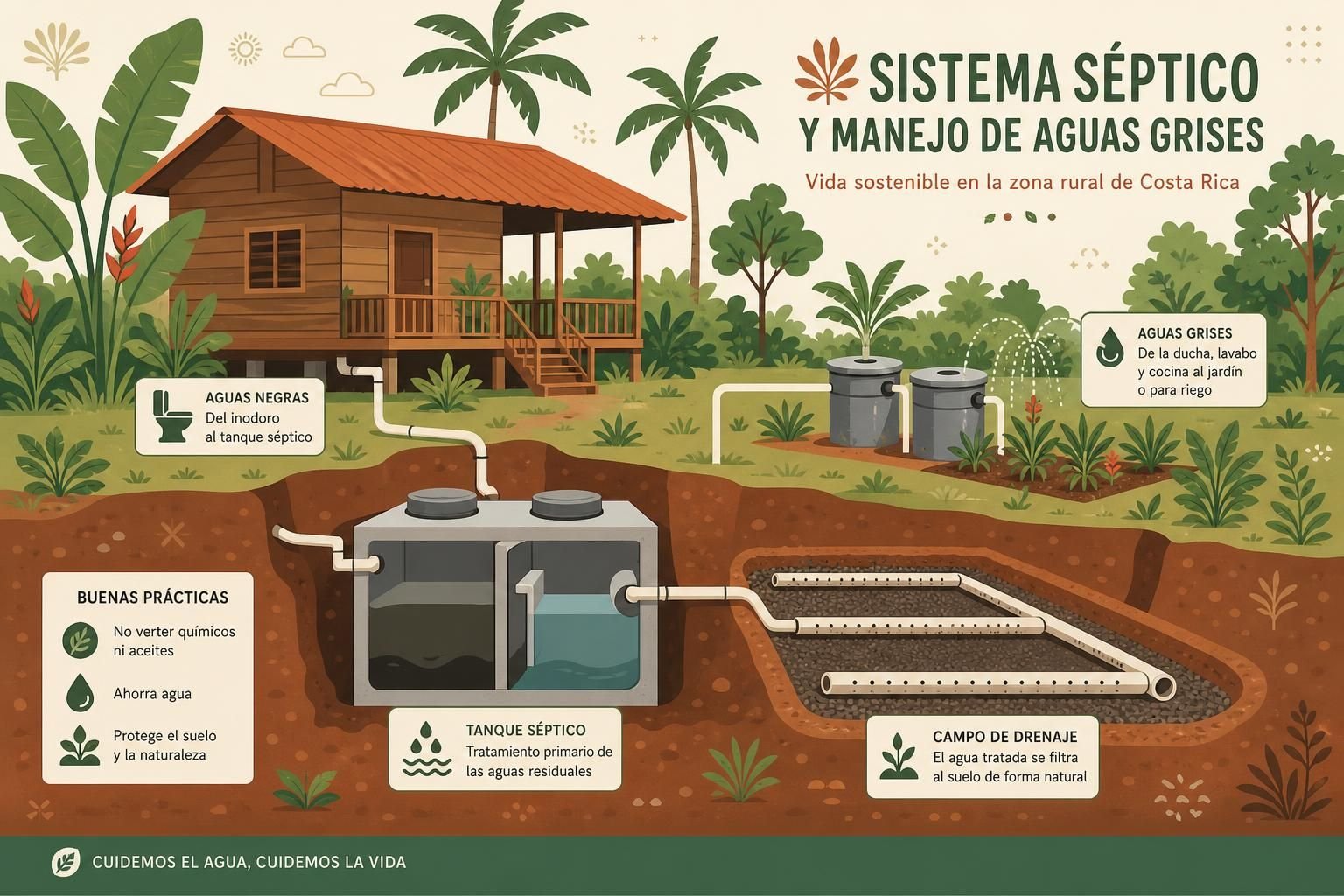
Every home needs an approved way to treat wastewater, and in Costa Rica treatment systems are approved under Decree 39887-S-MINAE. In practice that means a properly designed system, placed away from the spring or well you drink from, and approved before your building plans are reviewed.
Three rules shape what you can install:
- Location permit first: under Decree 39887-S-MINAE, the treatment system needs a location permit before the construction plans can be reviewed, and that permit does not replace any other agency’s requirements.
- Discharge limits: treated water that is discharged or reused must meet the limits in Decree 33601-MINAE-S, the national regulation on wastewater discharge and reuse.
- Rules under review: in 2026 the Ministry of Health opened a public consultation on reforming several articles of Decree 39887, so have your engineer confirm the version in force when you design.
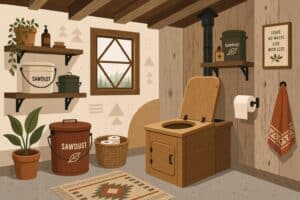
Composting toilets are popular with eco-minded owners, but don’t assume one lets you skip an approved system. Ask the municipality what it requires before you design a home without a septic tank.
Greywater from sinks and showers can water a garden; our guide to greywater systems for cabins explains the options. Trash pickup varies by area, so ask neighbors how it works where you are looking; some communities include trash and compost collection in their fees.
Internet in Remote Areas: Starlink and Fiber
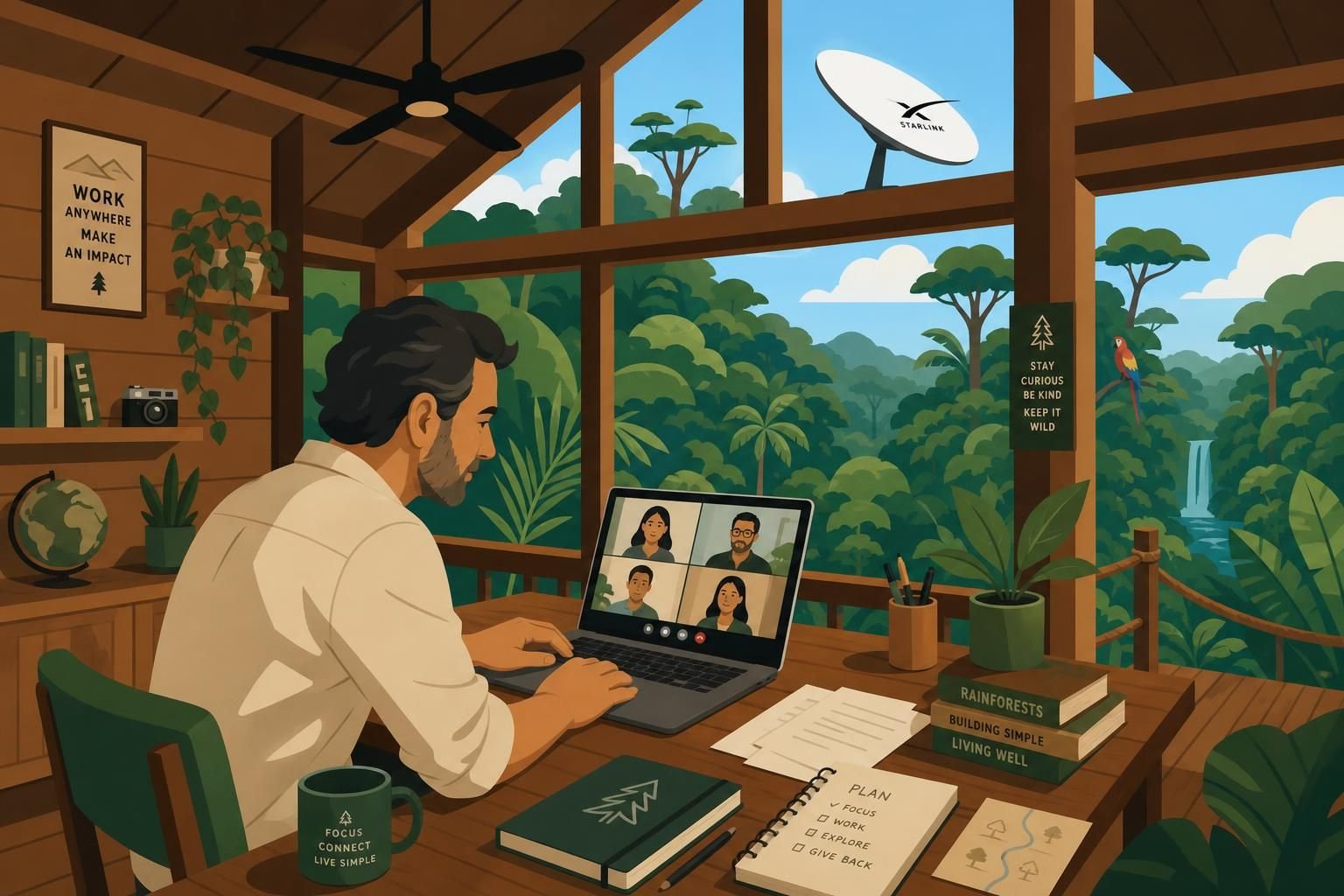
Remote work is possible on a lot of off-grid land in Costa Rica: satellite internet reaches places without cable, and some eco communities have fiber. Starlink received its Costa Rican license in 2023, after a SUTEL recommendation that April, and residential plans were reported from ₡23,000 a month in November 2025; check the current price before you budget.
For a community estimate, Nanku Ecovillage in Nosara puts internet at $80 to $120 a month, and some communities include fiber in their monthly fees (see the cost table below). The founders list connectivity among their five checks before buying: “Water availability, legal access, road conditions, building permissions and internet connectivity are all things I’d investigate thoroughly.”
- Ask which providers serve the land today.
- Check phone signal, and the open sky where a dish would go; tall forest and steep ridges can block it.
- Run a video call on site at the time of day you’d work.
- Add the dish and router to your solar load list, since they run all day.
The Best Place to Live Off-Grid in Costa Rica: Climate by Region
The best region depends on which constraint you’d rather manage: the Pacific slope gives strong dry-season sun but makes water the limit, while the Caribbean has rain in every month but less steady sun. The table uses one official source for every row: the climate regions of the Instituto Meteorológico Nacional (IMN), Costa Rica’s national weather service, and its 2026 drought reports. Check the real conditions on any land you consider, since they vary by valley and elevation.
| Region | Seasons | Solar and batteries | Water and storage | OGD guide |
|---|---|---|---|---|
| Pacífico Norte (Guanacaste and the Nicoya Peninsula) | Pacific regime: one well-defined dry season and one rainy season, wettest in September and October; El Niño years bring prolonged dry spells here, and 2026 was a drought year | Strong sun in the dry months; still size for wet-season output | Water is the limit: measure flow in March and plan large storage | Guanacaste |
| Pacífico Central and Pacífico Sur (including the Osa Peninsula) | Pacific regime, wettest in September and October; in drought in 2026 | Extra battery margin for cloudy rainy-season stretches | Rainy months refill tanks; store for the dry months | South Pacific |
| Región Central (Central Valley, including the San Mateo communities at about 300-600 m) | Pacific regime; in drought in 2026 along with the Pacific slope | Check cloud cover at the exact site | Plan dry-year storage; confirm the water source before buying | San José and Central Valley |
| Caribe Norte and Caribe Sur | No marked dry season; two relatively dry periods, February to April and September to October; El Niño years are wetter here, and for August 2026 the IMN forecast rain 40-60% above normal | Expect cloud through more of the year: more panels or battery margin, plus a generator | Roof collection is steadier, but still size tanks for dry spells and plan for drainage | Caribbean Coast |
| Zona Norte (Arenal and the Northern Plains) | A separate IMN region between the two slopes; in 2026 the IMN included its western part in the drought | Plan battery backup for cloudy periods | Where streams run year-round, micro-hydro may be possible with a concession; check the west of the zone for dry-year storage | Arenal and Northern Plains |
On the Pacific side, the sunniest months are also the driest, so you size solar for October and water for March. On the Caribbean side, you can’t count on a long sunny season to catch up on charging, so plan a bigger battery bank and a generator.
Roads follow the seasons too. “A perfectly accessible road in February can become a completely different adventure in October!” the founders say. Think about how you’ll get fuel, batteries and groceries in the wettest month.
Buying Land for an Off-Grid Homestead in Costa Rica: What to Check
Check water, legal access and what you’re allowed to build before anything else; a view can’t make up for land you can’t get a permit on. “Costa Rica has some absolutely beautiful land, but a stunning view doesn’t necessarily mean the property is suitable for off-grid living,” the founders say.
- Water letter: a valid letter from AyA or the ASADA, with its date and issuer.
- Water source and rights: a registered household well, a spring, or a use that needs a MINAE concession.
- Legal access: a public road or registered easement to the land.
- Land use: what the municipality allows you to build, and which permits you’ll need.
- The coast: keep outside the 200-meter maritime zone, or understand the concession rules.
- The road in both seasons: drive it in the dry season and again in the rains.
- Internet: test signal and satellite sky view on site.
- Sun, slope and soil: open sky for panels, a spring above the house for gravity feed, and room to grow your own food.
If any of the first four fails, walk away or make the deal conditional on fixing it. A local lawyer and the municipality, not the seller, are the people to confirm each one.
For a sense of range in November 2026: land for sale on Off Grid Destinations includes titled community lots of 3,840 to 4,725 square meters in Alegría Village at $199,000 to $285,000.
At the other end, a fully off-grid 32-acre farm near Ojochal, with a solar-powered home, well, spring and river, is listed at $549,000. Prices depend far more on location and water than on whether a property is off-grid.
Joining Intentional Communities and Regenerative Eco-Villages Instead
An established community can save you the hardest work, because water, roads and title are already in place; the trade-offs are monthly fees, shared rules and, often, a grid connection rather than true off-grid living. Several are active in Costa Rica:
- La Ecovilla, San Mateo: a regenerative community founded in 2012, where 48 families have turned 42 acres of former cattle land into a food forest.
- Alegría Village, San Mateo: 135+ residents from 34 countries on about 170 acres, with its own water grid, fiber internet, and national grid power plus home solar.
- Collectivo Tacotal, San Mateo: about 25 families on 60 acres, collectively owned since 2007 and run by consensus.
- Ecovilla San Mateo: 220 hectares along the Machuca River, with grid power plus home solar and syntropic agroforestry.
- St. Michael’s Sustainable Community, near Parrita: a permaculture community on individually titled lots, using springs, rainwater storage and solar.
- Nanku Ecovillage, Nosara: a 54-acre ecovillage, forming since 2022, describing solar, hydro and biomass energy.
Before you join, ask where the water comes from and who holds the letter or concession; whether power is grid, shared solar or home solar; what the fees cover; whether the land is titled; and how decisions are made. Our guide on how to join an eco community covers what to look for.
You can compare more on the communities page.
What Off-Grid Living Costs in Costa Rica
There is no reliable published figure for running a standalone off-grid home, because costs depend on your system, site and water source; what you can compare are dated examples and community charges. The founders’ answer on monthly costs: “Honestly, a lot less than living in the conventional world!” They add: “With solar providing the electricity and gravity-fed spring water, we eliminated two of the biggest ongoing utility expenses,” but “nothing is completely free. Batteries eventually need replacing, equipment requires maintenance, and there’s always the occasional unexpected repair.”
| Cost item | Figure | What to know |
|---|---|---|
| Solar equipment (founders’ system) | Around $11,000 in 2016 | 3.84 kW of panels, eight lead-acid batteries, a 3.6 kW inverter/charger; prices and technology have changed |
| Community fees, Alegría Village | $50 to $550 a month by lot size (2026) | Covers electric and fiber internet infrastructure, water service, trash and compost collection, common areas, roads and security |
| Electricity estimate, Nanku Ecovillage, Nosara | $250 to $700 a month (2026) | Electricity only, not total living costs |
| Internet | $80 to $120 a month (Nanku estimate); Starlink reported from about ₡23,000 a month (November 2025) | Check current Starlink pricing |
| Water system, permits, wastewater | Get quotes | Depend on the source, the municipality and the site |
| Battery and equipment reserve | Set aside monthly | Divide the replacement cost of the battery bank by its rated life in months |
To compare a community with a standalone home fairly, build a standalone budget that covers the same lines a community fee includes: power, internet, water, trash and road upkeep. Don’t mix the two community figures: Nanku’s is an electricity estimate, while Alegría’s fee bundles many services.
Residency Is a Separate Test
Residency income rules aren’t living costs, but they decide whether you can stay full time. Pensionado residency requires a lifetime pension of at least $1,000 a month and rentista residency $2,500 a month (CRIE, 2026). Investor residency continues; DGME’s published minimum was still $150,000 when checked in September 2026. Law 9996’s five-year window for new applicants to claim its import and tax incentives closed in July 2026, so confirm the current rules with the immigration authority (DGME) or an immigration lawyer before you plan around them.
Try Off-Grid Living in Costa Rica Before You Move
Before you move to Costa Rica for good, rent off-grid near your target area, ideally in both the dry and rainy seasons. The founders say it plainly: “I’d also strongly recommend visiting during both the rainy and dry seasons,” and “ideally, rent somewhere nearby before making the commitment.” Their reason: “the reality of living here can be quite different from the romantic idea people arrive with.”
Use the stay to answer real questions: How does the road feel in the wettest month? Does the spring or well hold up in March? How long do the batteries last on cloudy days? Is the internet good enough for work? How far is it to groceries, fuel and a doctor?
On Off Grid Destinations, Casita Selva is an off-grid jungle casita near San Juanillo on the Nicoya Peninsula. Listings are contact-only, so ask the owner directly about water, power and access.
Casitas inside the San Mateo eco communities let you try community life instead; browse all stays for current options.
FAQ
Can foreigners live off the grid in Costa Rica?
Yes. Foreigners have essentially the same land ownership rights as citizens, except in the 200-meter maritime zone, where the first 50 meters are public and the next 150 meters are held under concession. Residency is a separate process with its own income rules, so owning land does not by itself let you live in the country full time.
Do you need a permit for off-grid solar panels in Costa Rica?
Law 10086 recognizes “operación en isla,” self-generation that is not connected to the national grid, so you don’t need to connect to the utility to make your own power. The house itself still needs a municipal building permit, which in turn needs a water availability letter. Check with the municipality what it requires for your project.
Is water hard to get for off-grid land in Costa Rica?
Increasingly, yes. You need a water availability letter from AyA or an ASADA to get a construction permit, and about 1 in 4 development projects that request one are now turned down (2026). Check the letter, and the registration or concession for any well, before you buy.
What is the best region of Costa Rica for off-grid living?
It depends on which constraint you’d rather manage. The Pacific side has a December-to-March dry season with strong sun but scarce water, while the Caribbean side has no well-defined dry season. Central Valley foothills such as San Mateo are closer to services, but still need dry-season storage.
How much does off-grid living cost per month in Costa Rica?
There is no reliable published average, because it depends on the system and site. Community figures give a sense of range: Alegría Village fees run $50 to $550 a month and cover electric and fiber infrastructure, water service and shared upkeep, while Nanku Ecovillage estimates electricity alone at $250 to $700 a month. The founders found their own monthly costs much lower than conventional living, but budget for battery replacement and repairs.
The Bottom Line
Power is the easy part of off-grid living in Costa Rica; water and permits decide everything. Check water, access and what you can build before you buy, size solar for the rainy season and storage for the dry one, and rent nearby through both seasons first. Then weigh buying land against joining an established community. As the founders put it, “the more research you do beforehand, the better your experience will be.”
Sources
- Ley 10086 (UNEP LEAP / La Gaceta) (2021)
- The Tico Times (ICE data) (March 2026)
- The Tico Times (August 2026)
- The Tico Times (August 2026)
- Dirección de Agua (2016)
- Developing Telecoms; The Tico Times (November 2025)
- ECIJA (July 2026)
- CRIE (2026)
- Visit Costa Rica (ICT) (2026)
- Alegría Village FAQ (2026)
- Nanku Ecovillage (2026)
Researched and fact-checked by the Off Grid Destinations editorial team. Facts last checked November 13, 2026. Laws, taxes and prices change: confirm current figures with the source or a local professional.