Buying land in Costa Rica can go wrong in a way that a clean title will not show: the lot has no legal water, the zoning does not allow your home, or part of it sits in a protected strip along a creek. Most of those problems are visible before you sign if you know which documents to ask for and who issues them.
This guide gives you nine checks in order, from the water letter (carta de agua) to title, survey, zoning, river setbacks, road access and costs, with the official source behind each one.
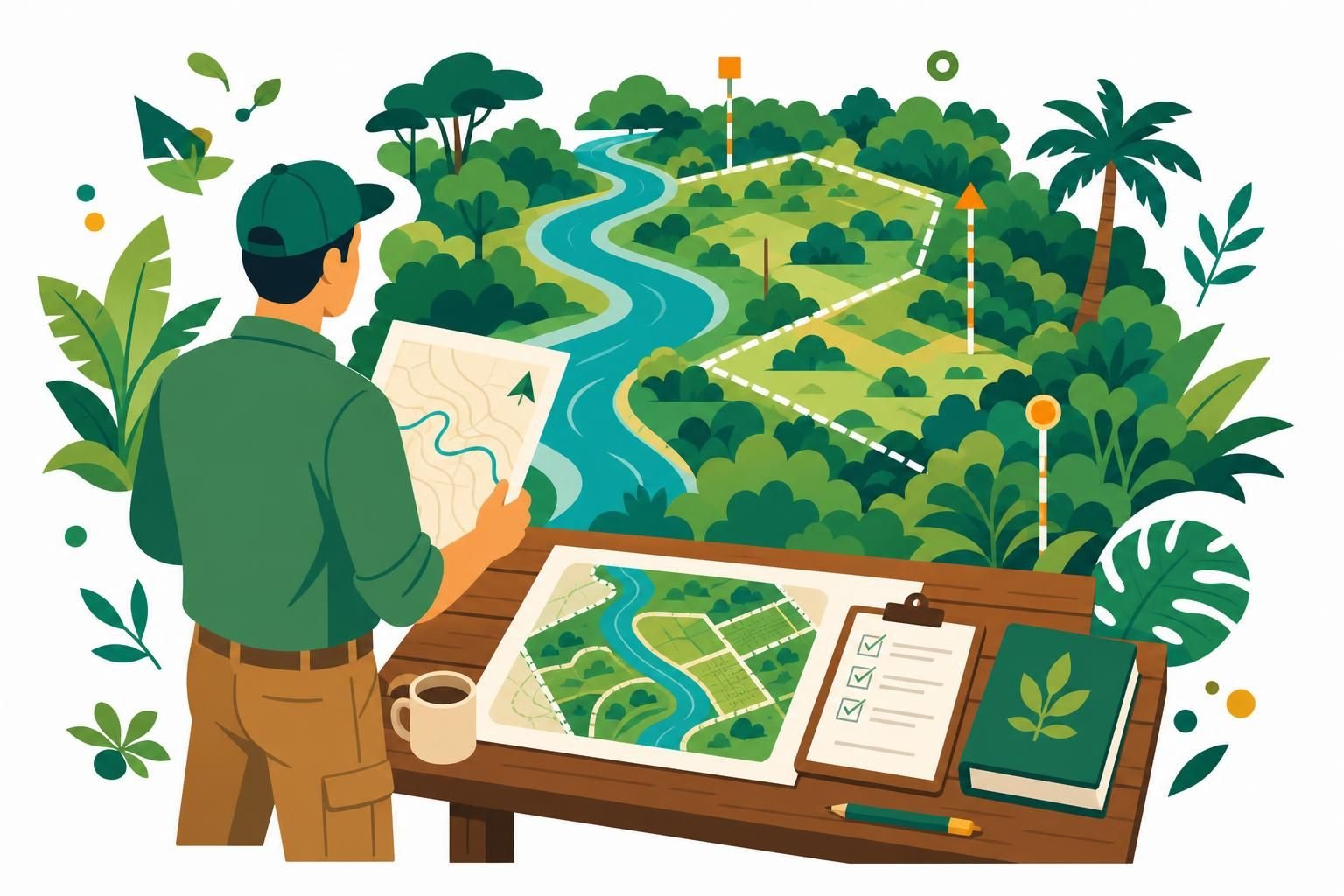
Key takeaways
- No building permit is issued in Costa Rica without proof of a legal water supply, so the water letter or a water concession comes first.
- Pull the National Registry record and the cadastral plan, then have a surveyor confirm the boundaries on the ground.
- Rivers, creeks and springs carry protection strips under the Forest Law (Ley 7575): 15 meters on each side of a rural creek on flat land, 50 meters on sloped land, 100 meters around a permanent spring.
- Foreigners can own titled land, but not the 200-meter maritime zone, the 2,000-meter border strip or land inside indigenous reserves.
- Budget 1.5% transfer tax plus notary and registry fees, and 0.25% a year in property tax.
Due diligence in brief: nine checks before you buy land
- Title and liens in the National Registry.
- The cadastral plan and the real boundaries.
- The water letter or a water concession.
- Land use and zoning at the municipality.
- River, creek and spring protection strips under Ley 7575.
- Restricted land and hazards: maritime zone, border strip, indigenous reserves, flood and landslide maps.
- Legal road access and easements.
- Taxes and closing costs.
- Your own lawyer, escrow and a purchase agreement that makes every check a condition.

Check 1: Title and liens in the National Registry
Land in Costa Rica is registered in the National Registry (Registro Nacional), and the registry record shows who owns a property and what is registered against it. Before you sign, your lawyer pulls that record.
What the registry certificate shows
A literal certificate (certificación literal) shows the registered owner, the property’s size and location data, and what is registered against it: mortgages, liens, easements and annotations of pending legal matters. The Registry also issues a certificate of liens (gravámenes) and a history of owners. Check that the seller in your purchase agreement is the registered owner, and that every lien will be cancelled at closing.
How to order registry certificates online
The National Registry sells these certificates online at rnpdigital.com, where basic searches are free, and Banco de Costa Rica branches also issue digital Registry certificates. A certificate shows one day’s record, so your lawyer checks again just before closing.

Check 2: The cadastral plan and the real boundaries
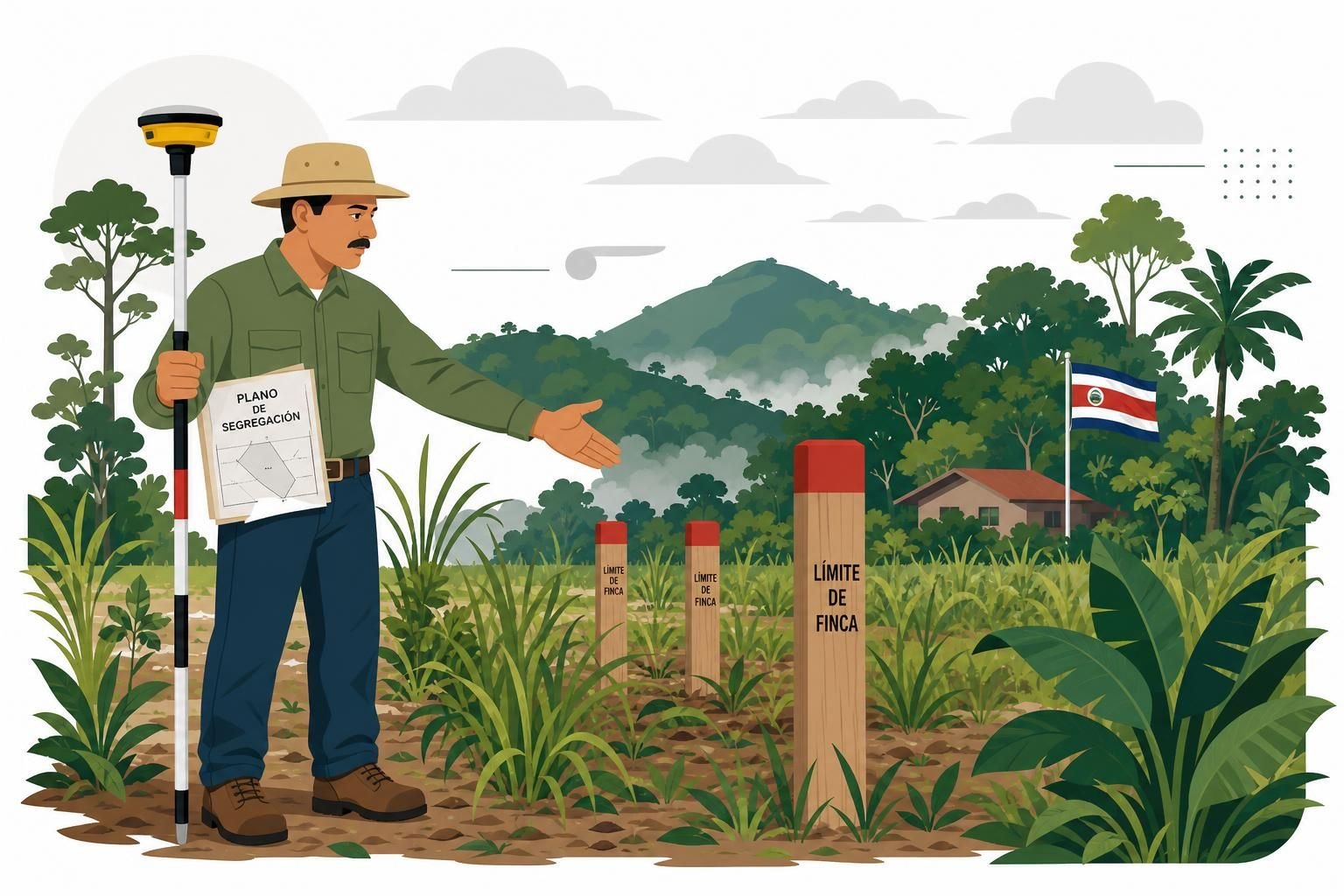
The cadastral plan (plano catastrado) is the registered survey map of the parcel. Its number and area should match the registry record, and its boundaries should match the land on the ground, so hire a licensed surveyor (topógrafo) to walk the corners.
New or corrected plans take time: in September 2024 the Association of Surveyors warned that the Real Estate Registry could take at least two months to process a cadastral plan. If the lot is being split from a larger property (a segregation), ask whether the municipality has approved the plan.
Check 3: The water letter (carta de agua) and water rights
You cannot get a building permit in Costa Rica without proof that the parcel has a legal water source, so water availability is the check that most often decides whether a lot can become a home. It is also getting harder: by August 2026 roughly one in four development projects that asked for a water availability determination were being turned down, and a positive answer generally holds for about twelve months if construction has not started.
Who issues the water letter and how long it takes
For a public supply, the proof is a water availability letter (constancia de disponibilidad de agua) from the provider for that area: AyA, the municipality, ESPH or the local ASADA, the community water association. The letter is free, and AyA must answer within 15 business days. Ask for a letter for this exact parcel and your intended use, and do not rely on an old water letter from the seller without checking it is still valid.
What the water letter proves and what it does not
The letter shows that the provider can supply the lot. It does not make the lot buildable on its own: the municipality still applies zoning, setbacks and the protection strips below. If the provider says no, building needs another legal water source such as a concession, so treat a refusal as a serious warning and make the letter a condition of your purchase agreement.
Read what the letter actually says. It should name the exact parcel, the provider, the use it covers and any conditions, such as paying for a line extension or a limit of one dwelling. A letter for a single home does not automatically cover a rental unit or a second building, and a letter the seller got years ago may have lapsed.

Wells, springs and water concessions
Water from a spring or stream needs a concession from MINAE’s Water Directorate (Dirección de Agua); without one, using it is not legal even on your own land. A drilled well on the property needs a drilling permit, a concession and a technical opinion from SENARA. A hand-dug well for domestic use does not need a concession. Ask for every permit and concession document and have your lawyer confirm they are current.
Check 4: Land use, zoning and the building permit
The municipality’s land-use certificate (certificado de uso de suelo) is usually the first step before building. It states what type of construction is allowed on the parcel, how many floors and the maximum share of the lot you can build on, under the canton’s zoning plan (plan regulador). Requirements differ by canton and some cantons have no zoning plan, so ask the municipality where the land is, and get the certificate before you sign. Check that it fits your intended use: a home, a casita, rentals or a business.

Check 5: River, creek and spring protection strips
Ley 7575, the Forest Law, makes the land along water into protection areas (article 33), and prohibits cutting or removing trees in them (article 34), except in projects declared of national interest.
| Water feature | Protection area |
|---|---|
| Permanent spring (naciente) | 100 m radius |
| River, stream or creek, rural area, flat land | 15 m on each side |
| River, stream or creek, urban area, flat land | 10 m on each side |
| River, stream or creek, sloped land | 50 m measured horizontally |
| Natural lakes and reservoirs | 50 m from the shore |
A creek on a parcel means part of it is likely a protection strip where you cannot clear trees or build. Ask the surveyor to draw the strips on the plan and calculate the area left to build on. Two of the Alegría Village lots for sale on Off Grid Destinations are creekside, Lot 20 Los Altos and Lot 70 Colinas, so this is the check to ask about there, as it is for any land with a creek.
Check 6: Restricted land and natural hazards
Foreigners have the same property rights as Costa Ricans under Article 19 of the Constitution and can hold titled land in their own name. Some land, though, cannot be owned by anyone privately, or not by you:
- The maritime zone: the 200 meters inland from the high-tide line under Ley 6043. The first 50 meters are a public zone and the next 150 meters a restricted zone held by concession, not title.
- The border strip: a 2,000-meter-wide strip along the borders is inalienable state land under the Land and Settlement Law (Ley 2825, article 7), administered by INDER.
- Indigenous reserves: under the Indigenous Law (Ley 6172, article 3), reserve land is non-transferable and cannot be bought or leased by non-indigenous people.
- Flood and landslide risk: the national emergency commission (CNE) maps natural hazards, and municipal zoning plans use those maps. Ask the municipality whether the parcel is in a hazard area.
Check 7: Legal road access and easements
Check that the parcel touches a public road, or that a registered easement (servidumbre) gives legal road access, and that the easement appears in both the registry record and the cadastral plan. Access that depends on a neighbor’s goodwill is not legal access. Also check easements that cross the parcel, such as power lines, water pipes or a neighbor’s right of way.
Check 8: Taxes and closing costs for land
| Cost | Rate | When |
|---|---|---|
| Transfer tax | 1.5% (Ley 6999, article 8) | At closing |
| Registry stamps and notary fees | Vary: get a written quote | At closing |
| Property tax | 0.25% a year of the registered value, paid to the municipality (Ley 7509) | Yearly |
| Luxury home tax | Not on land without a home; on homes only above a construction value of ₡143,000,000 in 2026 | Yearly |
Ask the notary for a full written estimate of closing costs before you transfer the purchase price.
Check 9: Your lawyer, escrow and the purchase agreement
Real estate agents in Costa Rica are not required to hold a license, and the transfer deed is executed by a notary public, who must be a lawyer. Hire your own independent Costa Rican attorney, not the seller’s, and use an escrow company registered with SUGEF, Costa Rica’s financial regulator, for every deposit, never a transfer to a person.
Then make each check a condition of the deal. Ask your lawyer to include:
- A deposit held in escrow, refundable if any check fails.
- A due-diligence period with a fixed date.
- A clean registry certificate, with liens cancelled at closing.
- A cadastral plan that matches the registry and the ground.
- A valid water letter or water concession for the parcel.
- A land-use certificate that allows your intended use.
- A survey showing the protection strips and the buildable area.
- Registered legal road access.
- Property taxes paid by the seller up to the closing date.
You can apply this checklist to the land for sale on Off Grid Destinations, such as the ridge lot Lot 96 in Alegría Village.
Frequently asked questions
Can foreigners buy land in Costa Rica?
Yes. Foreigners have the same property rights as Costa Rican citizens under Article 19 of the Constitution and can hold titled land in their own name. The exceptions are the 200-meter maritime zone, the 2,000-meter border strip and indigenous reserves.
What is a water letter in Costa Rica?
It is a letter from the water provider for the area (AyA, the municipality, ESPH or the local ASADA) confirming it can supply the parcel. A building permit requires it. The letter is free, and AyA must answer within 15 business days.
Does a water letter mean I can build?
No. It is required but not enough on its own: the municipality also applies zoning, setbacks and the Forest Law’s protection strips. Get the land-use certificate as well before you buy.
Can I drill a well if the lot has no water service?
A drilled well needs a drilling permit, a MINAE water concession and a SENARA technical opinion, while a hand-dug well for domestic use needs no concession. Check that a legal water source is possible before you buy, not after.
How long does land due diligence take?
It depends on the documents. AyA has 15 business days to answer a water request, and new or corrected cadastral plans have taken two months or more at the Registry, so agree a due-diligence period long enough to finish every check.
Confirm the water, then sign
When buying land in Costa Rica, start with water, title and zoning, then fall for the view. Browse the current land for sale and homes for sale, read the San Mateo area guide, and take an independent lawyer and a surveyor with you through every step.
Sources
- The Tico Times: water availability and property buyers (August 2026)
- Folio Costa Rica: confirm water before buying land (October 2026)
- International Surf Properties: escrow and closing (October 2026)
- Registro Nacional (rnpdigital.com) (2025 service guides)
- CRHoy (2025)
- Delfino (September 2024)
- The Tico Times (updated after December 2025)
- Diario Extra (2026)
- Ley 7575 (Bufete de Costa Rica legal text) (text updated March 2026)
- ECIJA (2026)
- Ley 6043 (FAOLEX) (law in force)
- Ley 6999 text, eRegulations Costa Rica (law in force)
- Ley 7509 text, Municipalidad de Santa Ana (law in force)
- EY tax alert (23 December 2025)
- ECIJA (2026)
Researched and fact-checked by the Off Grid Destinations editorial team. Facts last checked November 12, 2026. Laws, taxes and prices change: confirm current figures with the source or a local professional.