The best country to live off the grid is the one where the law lets you do three things: own the land, use its water and stay long term. Judged on those three, Costa Rica is the strongest choice for most North Americans and Europeans, and Ecuador is the lower-cost runner-up. Both let foreigners hold title to land, both have a formal process for legal water, and both offer residency on a pension: about $1,000 a month in Costa Rica and about $1,446 a month in Ecuador in 2026.
Most “best places to live off grid” lists rank countries on scenery and cheap land and skip the rules that decide whether you can actually build and stay. These six were chosen because they are the countries people most often weigh for off-grid life and where the rules can be checked against official sources; the same four checks work for any country you are considering. This guide compares six countries on land ownership, water rights, residency and building permits, using laws, government pages and legal sources, adds what life is really like from Off Grid Destinations’ founders, who have lived off-grid in Costa Rica since 2012, and flags the rules that are changing right now.
Key takeaways
- Best overall: Costa Rica. Foreigners get essentially the same land rights as citizens, a clear water process and a $1,000-a-month pension route (see our guide to off-grid living in Costa Rica).
- Lower-cost runner-up: Ecuador. Title is open to foreigners outside border and security zones, and the retiree visa needs about $1,446 a month in 2026 (see our guide to off-grid Ecuador).
- Water decides more than scenery. In Costa Rica no water letter means no building permit, and about 1 in 4 development projects asking for one were being turned down in 2026.
- Permits are enforced. In 2026 one Algarve council in Portugal ordered roughly 70 unpermitted dwellings demolished.
- New Zealand and Canada are hard for foreign buyers, and Canada’s ban may be extended to 2029.
- From people who live it: slow everything down, manage your expectations, and build so you can fix things yourself.
The best off-grid countries at a glance
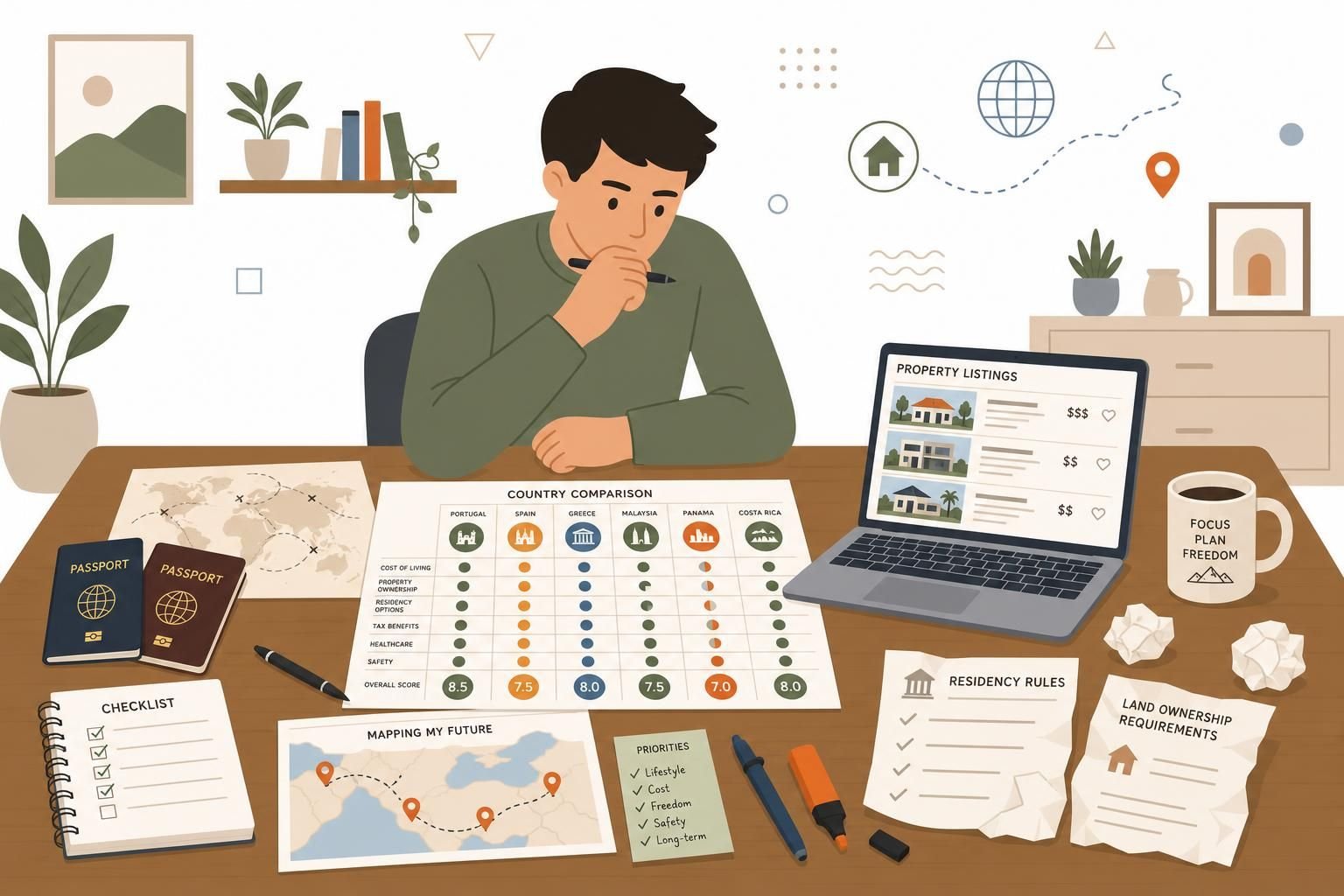
This table compares the six countries on the three gates that decide whether off-grid life is legal for a foreigner, plus the main catch in each. Figures are for 2026.
| Country | Can foreigners own land? | Legal water | Residency route (2026) | Main catch |
|---|---|---|---|---|
| Costa Rica | Yes, same rights as citizens, full title; not the 200 m coastal zone | Water availability letter (AyA or ASADA), or a registered or concessioned well | Pensionado: $1,000/month pension; rentista: $2,500/month | Water letters are getting harder to get |
| Ecuador | Yes, except border areas and national security zones | ARCA availability certificate, then a use authorization | Jubilado: pension of 3x the basic wage, about $1,446/month | Confirm the zone before you buy |
| Panama | Yes, except within 10 km of the borders | Local permits; confirm in writing | Pensionado: $1,000/month lifetime pension | Border rule and island title issues |
| Portugal | Yes | A borehole needs an APA licence | D7: €920/month passive income plus savings | Strict building rules on rustic land |
| New Zealand | Mostly no without consent; Australians and Singaporeans can buy homes | Regional council rules | No simple pension route | Foreign buyer rules shut out most newcomers |
| Canada | Not homes in cities and towns; rural land outside census areas is open | Provincial rules | No simple pension route | Ban runs to January 1, 2027, may be extended |
In short: Costa Rica, Ecuador and Panama clear all three gates for someone with a qualifying pension. Portugal clears them too, but punishes building without a permit. New Zealand and Canada are realistic mainly if you are already a resident.
What makes a country good for off-grid living
Solar panels and rain tanks work almost anywhere. What differs from country to country is whether the law lets you use them on land you own, in a place you are allowed to stay. Four checks decide it.
| Check | The question to ask | Why it matters |
|---|---|---|
| Land | What are the foreign ownership rules: will I hold full title, a concession, or only buy with government consent? | Full title is yours; a concession is a lease with renewal risk; consent can be refused. |
| Water | Who owns the groundwater, and what permit lets me use it? | In many countries the state owns it, and a building permit needs proof of legal water. |
| Residency | Which route fits my kind of income, and how much must I prove? | Owning land does not let you stay. |
| Permits | Can I legally build and live on this exact parcel? | Unpermitted homes can be ordered demolished. |
Sort yourself by income before you compare thresholds. A lifetime pension fits Costa Rica’s and Panama’s pensionado routes and Ecuador’s jubilado visa. Other passive income, such as rent or investments, fits Costa Rica’s rentista route ($2,500 a month) and Portugal’s D7. Thresholds tied to a minimum wage rise most years, so check the figure in the year you apply.
Rainfall, space and prices: the six countries compared
Two things shape everyday off-grid life wherever you go: how much rain falls, which drives your water supply and growing season, and how much room there is around you. The World Bank measures both the same way for every country (average precipitation, population density), and its price data shows how expensive each country is compared with the US (price level = purchasing-power conversion factor divided by the market exchange rate, World Bank, 2024), so the comparison is like for like.
| Country | Average rainfall (mm a year, 2022) | People per km² (2024) | Price level (US = 100, 2024) | What it means off-grid |
|---|---|---|---|---|
| Panama | 2,928 | 61 | 46 | Very wet: easy rainwater, hard on unpaved roads in the rainy season. |
| Costa Rica | 2,926 | 101 | 60 | Plenty of rain overall, but the Pacific side has a dry season of four to five months, so plan storage. |
| Ecuador | 2,274 | 73 | 43 | Wet on average, with huge differences between the coast, the Andes and the Amazon. |
| New Zealand | 1,732 | 20 | 89 | Moderate rain and plenty of space. |
| Portugal | 854 | 117 | 56 | Dry summers and the most crowded country here: water storage and borehole licensing matter most. |
| United States | 715 | 37 | 100 | Varies more by region than any other country on the list. |
| Canada | 537 | 5 | 84 | The most space by far; winter, not rainfall, is the constraint. |
National averages hide big regional differences, so check the rainfall and dry-season length for the region you are looking at, not just the country.
Costa Rica: the best overall choice
Costa Rica is the best country to live off grid for most people because it combines open land ownership, a defined process for legal water, a realistic pension route and a long-established off-grid and eco community scene. Its catch is water: plan the purchase around the water letter, not the view. See our Costa Rica destination guide.
Ownership and the 200-meter maritime zone
Foreigners have essentially the same ownership rights as citizens, with full title recorded in the National Registry and no need to be a resident (ECIJA, 2026). The exception is the coast: the first 200 meters inland from the high-tide line. The first 50 meters are public, and the next 150 meters are held by concession for about 5 to 20 years, not owned. A foreigner with under five years of legal residency is generally limited to a minority stake of up to 49% in such a concession. For an off-grid home, the simple answer is to buy inland, where you can hold full title.
Water letters and wells
Without a valid water availability letter from AyA, the national utility, or the local community water association (ASADA), the municipality will not issue a construction permit. In 2026 roughly one in four development projects that asked for a water availability determination were being turned down, and a positive answer generally holds for about twelve months if construction has not started (The Tico Times, August 2026).
Groundwater is national property. A hand-dug or artesian well used only for the household on the same farm needs registration, not a concession; anything beyond that, including rentals, needs a full concession from MINAE’s Water Directorate. A rainwater tank is a good backup, but it is not one of the legal water sources a permit relies on. Get the letter or the well registration in writing before you sign.
Residency and costs
The pensionado route needs a lifetime pension of $1,000 a month in your own name, and the rentista route $2,500 a month in passive income. The investor category continues, but Law 9996’s incentives, such as duty-free household goods and vehicles, ended for new applicants after July 14, 2026, and sources disagree on whether the investment minimum is now $150,000 or $200,000 (CRIE, 2026). Confirm it with the immigration authority (DGME) before you plan around it.
At closing, budget the 1.5% transfer tax plus registry and notary fees, then 0.25% a year in property tax on the registered value. For a sense of inland prices, titled lots of 3,840 to 4,725 m² in one San Mateo eco community were listed at $199,000 to $285,000 in November 2026; browse land for sale to compare.
Ecuador: lower costs, but check the zone
Ecuador has the lowest prices of the six, with a price level about 43% of the US level in 2024 (World Bank), climates from the Andes to the edge of the Amazon, and the US dollar as its currency. It clears all three gates, as long as the land sits outside the restricted zones. See our Ecuador destination guide.
Border and national security zones
Ecuador gives foreign investors the same treatment as locals with one firm exception: the constitution bars foreigners from owning land in border areas or designated national security zones. Foreign-controlled companies also need approval from the National Agrarian Authority to buy rural land for farming or forestry (Chambers Real Estate 2026). Before you sign, have a local lawyer confirm the parcel’s zone status in writing.
Legal water
Water use runs in two steps: ARCA, the water regulator, issues a water availability certificate, and that certificate is needed for a water use authorization (gob.ec). Whether the property uses a spring, a stream or a well, ask which authorization already covers it and whether it passes to you.
The retiree visa
The jubilado temporary residence visa needs a foreign pension of at least three times the basic unified wage (gob.ec). The 2026 basic wage is $482, so the bar is about $1,446 a month, and it moves with the wage each year. To try Ecuador before buying, Fruit Haven Ecovillage in Gualaquiza, a member-run permaculture fruit farm of over 130 hectares with off-grid solar and stream water, takes guests and volunteers.
Panama: a simple pensioner route, with a border rule
Panama’s pensionado visa needs a lifetime pension of $1,000 a month, the same headline figure as Costa Rica, which makes it a natural third option. The land rule to know: foreigners may not own real property within 10 kilometers of the national borders. Island land can also carry title complications, so have a lawyer check the property records closely.
Water works by permit. Under Decree-Law 35 of 1966, a right to use water is acquired only through a permit or a concession from the environment ministry, MiAmbiente, with domestic use given priority (Decree-Law 35, MiAmbiente). Enforcement is catching up: MiAmbiente has reported that more than 2,500 wells drilled across the country have no permit or registration (MiAmbiente). Ask the seller for the well’s permit and registration, and treat a well without them as a cost to fix, not a feature.
Portugal: the lowest income bar, the strictest building rules
Portugal’s D7 visa needs €920 a month in passive income for one person in 2026, which is the national minimum wage, plus €11,040 in savings; add 50% for a spouse and 30% per child (Portugalist, November 2026). The 2027 budget assumes a higher minimum wage, so the bar is likely to rise. Confirm the figures with a Portuguese consulate.
Buying is open to foreigners. Building is where plans fail. In April 2026 the Castro Marim council in the Algarve ordered the demolition of roughly 70 unauthorized dwellings, and Portugal has no legal category for mobile or improvised homes outside the planning rules (The Portugal Post). A caravan or cabin on cheap rustic land is not a legal home. Look for land with an existing permit, get the council’s answer on what you may build in writing, and remember that a borehole needs a licence from the Portuguese Environment Agency (APA).
New Zealand: great if you are a resident
Since October 2018, most overseas buyers need consent from the Overseas Investment Office to buy residential land, while Australian and Singaporean citizens can buy residential or lifestyle property (LINZ). Since early 2026, holders of the Active Investor Plus visa can also apply to buy one home worth NZ$5 million or more (LINZ guidance), which is a narrow exception, not an opening. For most people the realistic path is residence first, land later.
Canada: rural land only, and long winters
Non-Canadians are barred from buying residential property of three units or fewer, but property outside census metropolitan areas and census agglomerations is exempt (Justice Canada), which covers much rural off-grid land. Check the exact parcel against the census map. The ban currently ends on January 1, 2027; Budget 2026, tabled on November 5, 2026, proposes extending it to 2029 for existing homes and exempting new builds, but that still needs legislation (The Hub, November 2026). Plan on months of short days: insulation, heating and backup power matter more than anywhere else on this list.
What about the United States?
There is no national ban on off-grid living in the United States. The rules that decide it are local: county zoning laws and building codes, and state water law, which can limit even rainwater: Colorado, for example, lets most homes collect rain in no more than two barrels holding 110 gallons in total, for outdoor use only. Check the county and the state water office for the exact parcel before you buy, because what is allowed in one county can be refused in the next.
Wells are the other big difference from Latin America. About 43 million Americans, roughly 15% of the population, rely on private domestic wells (USGS), and private well water is not regulated under the federal Safe Drinking Water Act (EPA). That means less paperwork in many places, but testing and treating the water is entirely your job.
What long-time off-gridders in Costa Rica want you to know
Laws tell you whether you can live off-grid somewhere. They do not tell you what it is like. Off Grid Destinations’ founders, who have lived off-grid in Costa Rica since 2012 (read their own story of living off the grid in Costa Rica), shared the lessons that matter most:
- Why Costa Rica: the nature, the biodiversity, and more land than people. One of them always said as a kid they would escape to the jungle rather than get stuck in the concrete jungle.
- Everything is slow. “If you don’t embrace pura vida you will struggle in Costa Rica. Don’t fight it.”
- Manage your expectations. Don’t come for a change and then expect the same level of service and things you are used to back home.
- Repairs are the hidden challenge. If something goes wrong and you can’t fix it yourself, finding a person or company to help can be hard, and so can finding parts. “Build in a way that is easier to self-repair where possible.”
In practice, self-sufficiency here is as much about repairs as about solar panels. That last point is the one to plan around from day one: choose simple solar, water and septic systems with parts you can get locally, and learn how each one works before it breaks.
Off-grid communities: a lower-risk way in
Joining or visiting an established community lets you test a country before you commit your savings, with neighbors who already know the local rules. It does not replace your own lawyer’s checks on title, water and permits.
- Costa Rica: several eco communities sit side by side in the hills of San Mateo, and others are on the coast near Nosara and Santa Teresa. Compare them in our eco communities directory.
- Ecuador: for a taste of homesteading and sustainable living, Fruit Haven Ecovillage takes guests and volunteers.
- Anywhere: stay a few weeks, ideally in both the dry and rainy seasons, before you buy.
How to choose your off-grid country: a checklist
- Sort your income: lifetime pension, other passive income or work income.
- Check residency: $1,000 pension for Costa Rica and Panama, about $1,446 for Ecuador, €920 plus savings for Portugal, with room to spare as thresholds rise.
- Check the title type: full title, outside coastal, border and security zones.
- Confirm water on paper: the letter, certificate or registered well for that exact piece of land, with dates and permitted uses.
- Confirm you can build: get the municipality’s answer in writing on the home, existing structures and septic.
- Check the basics of remote living: access to healthcare, roads in the rainy season and internet.
- Check the climate for growing food and for solar: how long the dry season lasts and how much rain falls where the land is.
- Plan for repairs: simple systems, local parts, skills you can learn.
- Try before you buy: rent, visit a community or volunteer first.
- Hire your own local lawyer before you sign anything binding.
Frequently asked questions
What is the best country to live off the grid?
For most North Americans and Europeans, Costa Rica, with Ecuador as the lower-cost runner-up. Both let foreigners hold title to land, have a defined process for legal water and offer residency on a pension of about $1,000 (Costa Rica) or $1,446 (Ecuador) a month in 2026.
Can you legally live off the grid in another country?
Yes, in all six countries here, as long as you have legal water and a building permit for the home. Power is rarely the problem; unpermitted homes and water without a permit are, as Portugal’s 2026 demolition orders show.
Which country has the lowest residency bar?
It depends on your income type. Portugal’s D7 asks for €920 a month in passive income plus savings in 2026. On pensions, Costa Rica and Panama ask for $1,000 a month and Ecuador about $1,446.
Can a US citizen buy land abroad to live off-grid?
Yes in Costa Rica, Ecuador, Panama and Portugal, with zone exceptions in Ecuador and Panama and the coastal zone in Costa Rica. New Zealand requires consent for most overseas buyers, and Canada bars non-Canadians from homes in cities and towns until at least January 1, 2027.
The best place to live off-grid: choose by water and law, then scenery
If you want to go off grid abroad, the best place to live is the one where you can own the land, use its water legally and stay. For most people that points to Costa Rica first and Ecuador second. Start with the residency route that fits your income, confirm water and permits on paper for the exact parcel, then explore land for sale and the communities where you can try the life first.
Sources
- ECIJA (July 2026)
- The Tico Times (August 2026)
- CRIE (2026)
- Chambers Real Estate 2026 (Ecuador) (2026)
- gob.ec (ARCA) (2026)
- gob.ec (Cancillería) and El Universo (2026)
- Panama MICI trade schedule (2022)
- Kraemer & Kraemer (2026)
- Portugalist (November 2026)
- The Portugal Post (April 2026)
- LINZ (2026)
- New Zealand Law Society (2018)
- Justice Canada (SOR/2022-250) (2026)
- CIC News; Vanplex (2026)
- El Universo (December 2025)
- CRIE (2026)
Researched and fact-checked by the Off Grid Destinations editorial team. Facts last checked November 12, 2026. Laws, taxes and prices change: confirm current figures with the source or a local professional.