Searching for eco village homes for sale in Costa Rica quickly turns into comparing communities, not just houses. Whether you want a casa in the hills or a home near the beach, the same rule applies. Two homes with the same view can come with very different water, rules, fees and paperwork, and those differences decide what you can build, rent and resell.
As of November 2026, homes in Alegria Village near San Mateo are listed on Off Grid Destinations at $260,000 to $900,000, and building lots at $199,000 to $285,000. As a foreigner you can hold titled property in your own name. The three checks that matter most: which kind of title you are buying, written proof of legal water, and proof that the seller’s community fees are paid.
Key takeaways
- Current asking prices in Alegria Village, San Mateo: homes from $260,000 to $900,000, building lots from $199,000 to $285,000 (November 2026).
- Foreigners have the same property rights as Costa Ricans. The exception is the maritime zone along the coast, which is held by concession, not owned.
- No building permit is issued without proof of legal water, so the water letter or water concession comes before anything else on a lot.
- In a condominium, the buyer can be held liable for the previous owner’s unpaid community fees. Get a fee certificate before money changes hands.
- Budget 1.5% transfer tax plus notary and registry fees at closing, then 0.25% a year in property tax and the community’s fees.
What counts as an eco village home in Costa Rica
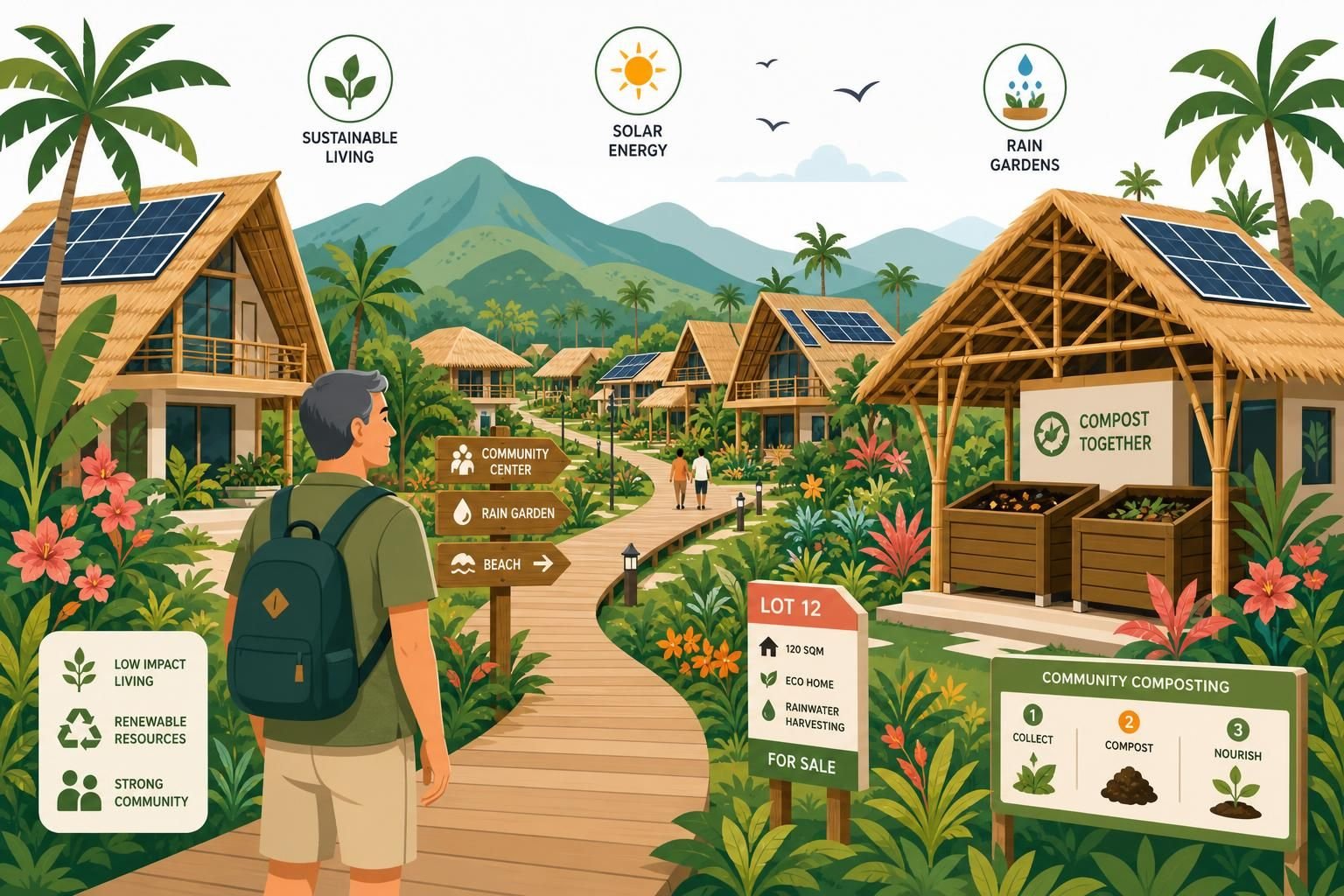
An eco village home (often written eco-village) is a house or lot inside a planned community built around shared land and nature: regenerated forest, food gardens, trails, shared spaces and often shared water and solar systems. Residents usually agree to common rules on building, land use and shared work.
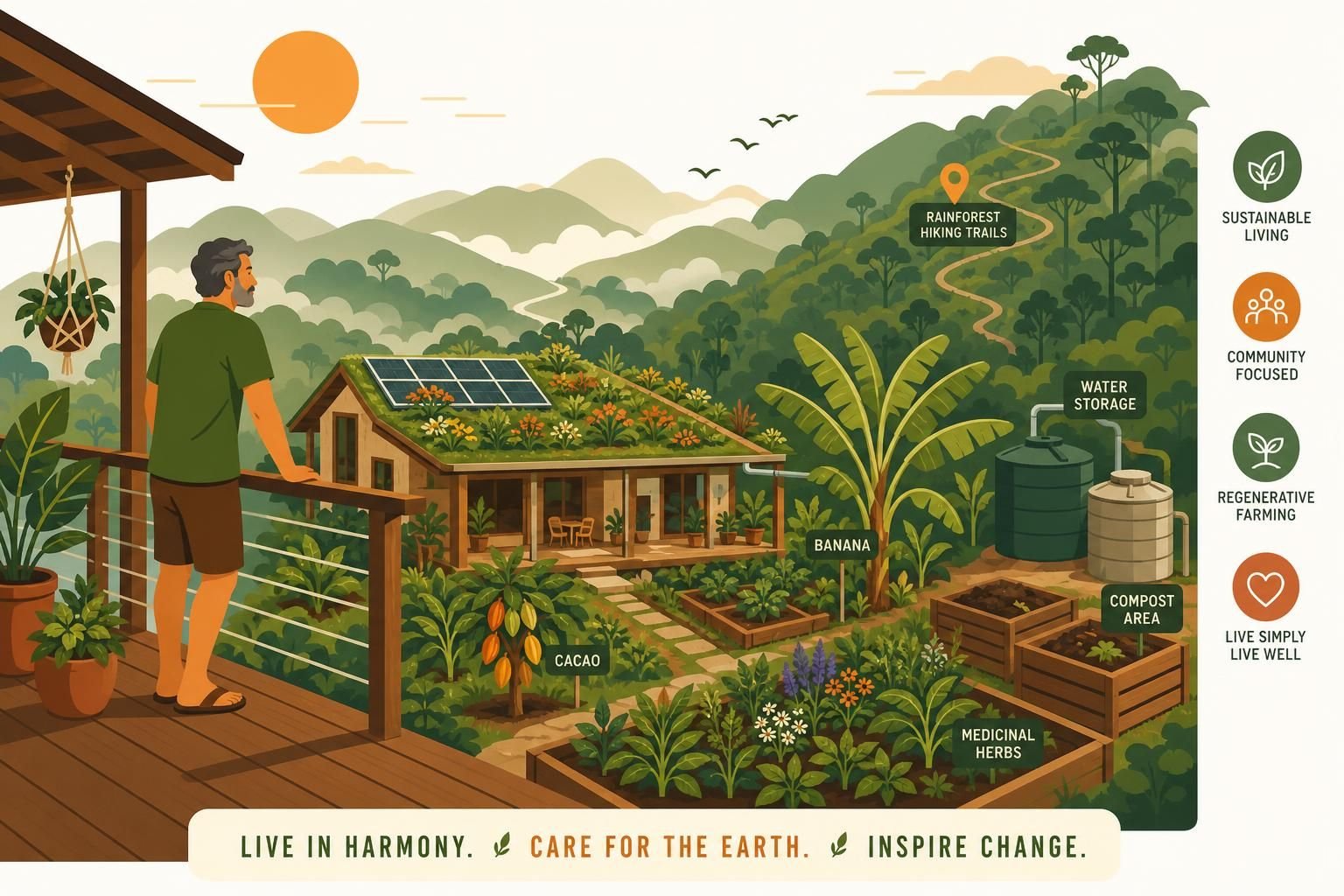
There is no legal category called “eco village” in Costa Rica. Legally, you are buying either an independent titled lot or a unit in a condominium, and that is what sets your rights, fees and obligations. Eco-friendly homes in these communities often add renewable energy, rainwater collection, compost systems and water conservation, designed to live in harmony with nature. Treat sustainability features as things to verify: ask who owns, runs and pays for the water system, the solar equipment, the roads and the shared spaces.
Eco villages, beach communities and gated communities
Homes for sale in Costa Rica sold as “eco” fall into three broad groups, and they suit different buyers.
| Type | Typical setting | What to check first |
|---|---|---|
| Inland eco village | Hills and valleys such as San Mateo, with shared land, gardens and trails | Title type, water source, community rules and fees |
| Beach community | Pacific coast towns in Guanacaste such as Tamarindo, or further south around Ojochal, often sold on ocean view and beach access | Whether any land is in the maritime zone, water supply, rental rules |
| Gated community | Resort-style developments, including golf and beach projects such as Hacienda Pinilla in Guanacaste | HOA fees and what they cover, rules, resale demand |
Beachfront and ocean view property near a playa can be appealing, but coastal land needs the extra maritime zone check described below. An inland eco village trades beautiful beaches on the doorstep for cooler hills, shared land and Costa Rica’s rich biodiversity close to home; compare prices area by area rather than assuming either is cheaper.
Where eco village homes are for sale right now
Most eco village properties in Costa Rica listed on OGD are near San Mateo, Alajuela, about an hour from San Jose’s international airport and 45 minutes from Jaco beach.
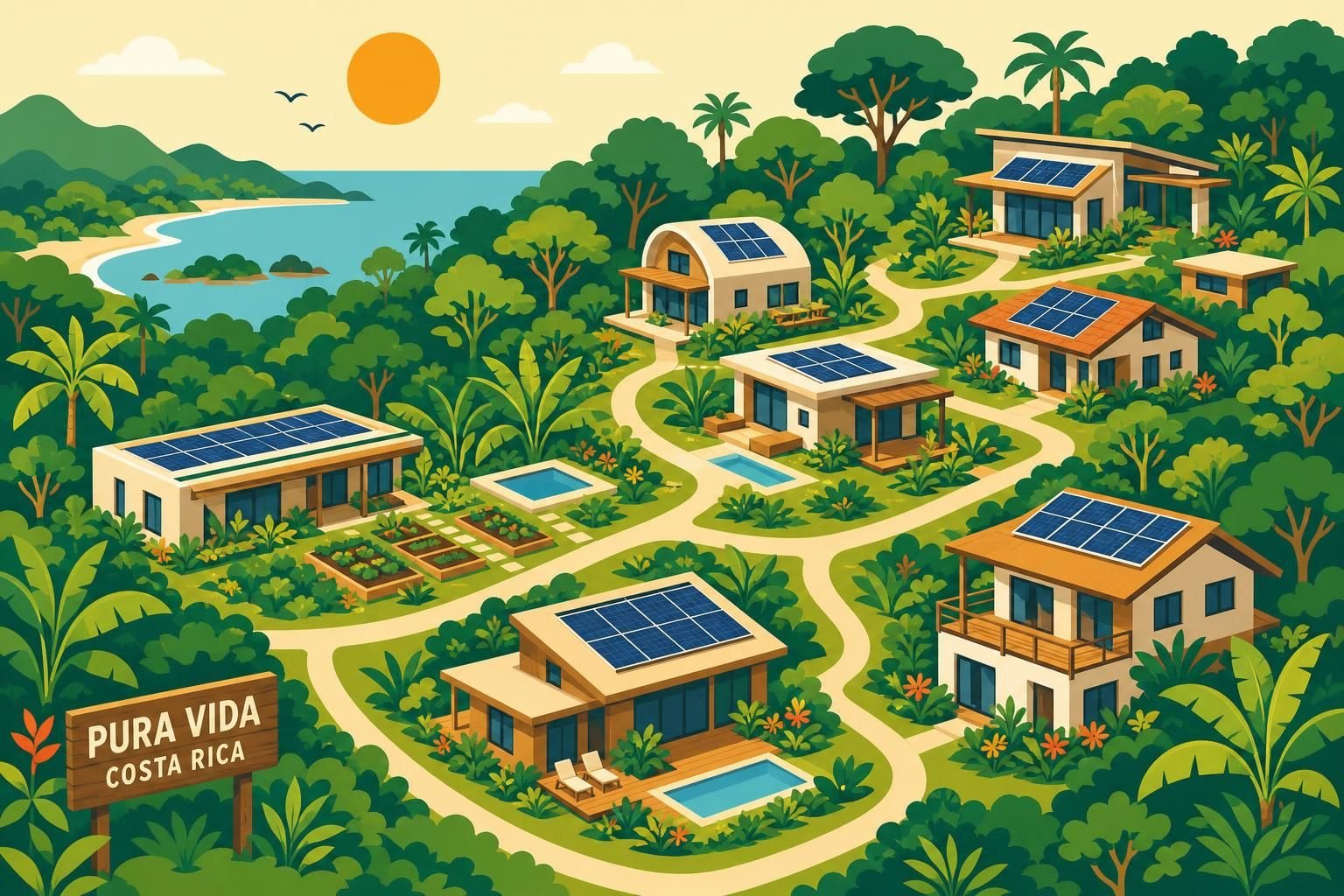
- Alegria Village, San Mateo: each house for sale here sits on its own lot inside a thoughtfully designed community; seven homes listed from $260,000 to $900,000 and four building lots from $199,000 to $285,000. Founded in 2018 on about 70 hectares, with on-site springs and grid power plus home solar. See the Alegria Village community page.
- La Ecovilla Original, San Mateo: several homes with two to four bedrooms on lots of 688 to 1,934 m², price on request. Operating since 2012, with 48 families. See La Ecovilla’s page.
- Other communities: new property offers appear as communities grow. Collectivo Tacotal, The ARK near Santa Teresa and others have their own pages in the communities hub. A community page describes the place; it does not mean a home is for sale there, so ask each one directly.
Browse every current listing on the homes for sale page and lots on the land for sale page, and read the San Mateo area guide for the surrounding area.
What eco village homes cost today
These are the asking prices for every home and lot listed in Alegria Village on OGD as of November 2026. They are asking prices, not sale prices, and the area shown is the area given in each listing.
| Property | Area | Built | Asking price |
|---|---|---|---|
| 1-bedroom home | 1,117 m² | not listed | $260,000 |
| 1-bedroom home | 3,296 m² | not listed | $375,000 |
| 2-bedroom, 2-bath home | 1,674 m² | 2023 | $439,000 |
| 2-bedroom furnished garden home with pool | 1,394 m² | 2024 | $549,000 |
| 3 independent units, 8 bedrooms in total | 974 m² | 2025 | $669,000 |
| Artist-designed 3-bedroom home | 2,200 m² | 2025 | $695,000 |
| 4-bedroom home with pool, casita and hybrid solar | 1,121 m² | 2024 | $900,000 |
| Building lots (4) | 3,840 to 4,725 m² | land | $199,000 to $285,000 |
Six of the seven homes are listed under $700,000. Price follows what is built, and the living space, more than land size: the 974 m² property with three units costs more than the 3,296 m² one-bedroom home. A lot suits you if you want to design your own home, but add design, permits and construction to the price, and confirm water before you commit. La Ecovilla Original’s homes are listed on request, so ask for the price and the community fees together.
Community fees vary. One Alegria Village listing shows an HOA fee of $120 without stating the period, so confirm the amount and whether it is monthly or yearly, in writing, for the exact home you want.
How ownership works inside an eco village
In any eco village you own something of your own and share something with your neighbors. What you own, and what you share, depends on the legal form of the property.
Can foreigners own property in Costa Rica?
Yes. Under Article 19 of the Constitution, foreigners have the same property rights as Costa Rican citizens and can hold titled property in their own name, without residency. The main exception is the maritime-terrestrial zone under Ley 6043: the 200 meters inland from the high-tide line, where the first 50 meters are public and the next 150 meters are held by concession, not owned. Inland communities such as those around San Mateo are not in that zone.
Titled lots vs. condominium units
Both are registered in the National Registry. The difference is what comes with them.
| Question | Independent titled lot | Condominium unit (filial) |
|---|---|---|
| What you own | A registered parcel and the home on it | Your unit, plus a share of the common areas |
| Rules you follow | Any community rules attached to the purchase | The condominium’s rules (reglamento) under Ley 7933 |
| Shared costs | Any fees the community sets | Common-expense fees for roads, water and shared spaces |
| Previous owner’s unpaid fees | Check with the community; liens show in the title study | The buyer is jointly liable and can claim them back from the seller |
| Documents to request | Title study and cadastral plan | Title study, cadastral plan, rules and a fee certificate |
Ask the seller which one you are buying, then have your own lawyer pull the registry title study (estudio de registro) and the cadastral plan (plano catastrado) to confirm it.
Community rules, fees and unpaid debts
Under Article 21 of Ley 7933, the Condominium Property Law, the buyer of a condominium unit is jointly liable for the previous owner’s unpaid common-expense fees, with the right to claim them back from the seller. Chasing a seller after closing, often across borders, is slow. The protection is simple: have your lawyer get a current fee certificate from the community administrator, dated close to closing, and make full payment of any arrears a condition of closing.
Read the rules as closely as the price sheet. If you plan rental income, check what they say about short-term and long-term rentals, building design and approvals, pets, shared work, how fees can rise and whether the community must approve a future buyer.
Water, power and permits to check before you buy
Water is the first check for any home or lot, because without legal water a lot cannot get a building permit.
The water availability letter
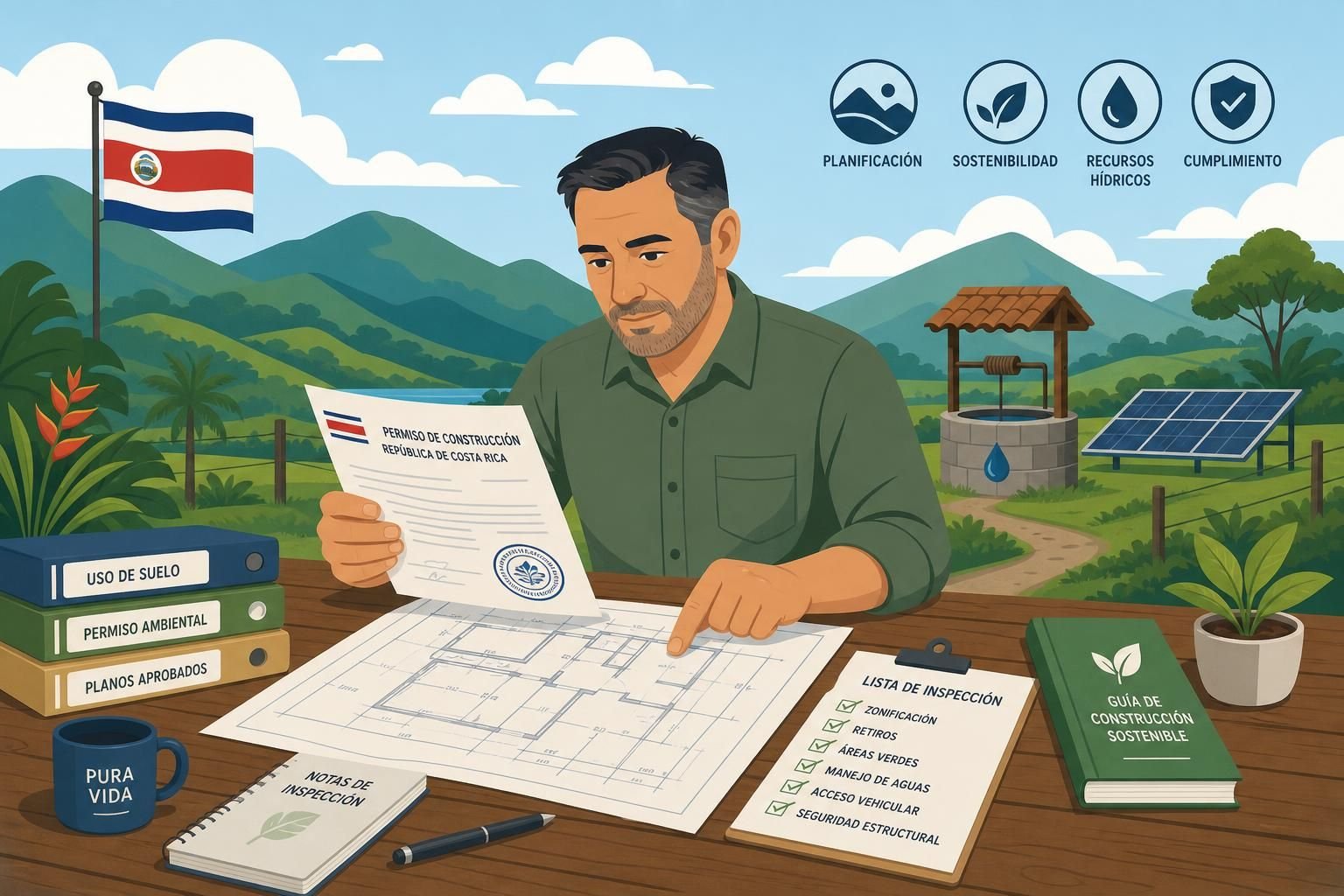
You cannot get a building permit in Costa Rica without proof that the lot has a legal water supply. For a public supply, that proof is a water availability letter (constancia de disponibilidad de agua) from the provider for the area: AyA, the municipality, ESPH or the local ASADA. The letter is free, and AyA must answer within 15 business days. For a lot, ask for the letter before you sign or make it a condition of the deal. For a built home, confirm the connection is legal and in whose name it is.
Wells, springs and water concessions
Some communities use their own sources. Water from a spring or stream needs a concession from MINAE’s Water Directorate (Dirección de Agua); without one, using it is not legal even on your own land. A drilled well needs a drilling permit, a concession and a technical opinion from SENARA. A hand-dug well for domestic use does not need a concession. Ask which source serves the home, see the concession documents, and ask how the system copes in the dry season.
Solar, grid and hybrid power
| Setup | How it works | What to ask for |
|---|---|---|
| Grid-connected | Power from the national network | Recent bills and outage history |
| Hybrid | Grid plus solar panels and batteries | System size, battery age and warranty, who maintains it |
| Fully off-grid | Solar and batteries, often with a generator | Battery capacity, backup plan, maintenance records |
Alegria Village listings include grid-connected homes and a hybrid solar home with a pool and terrace, which pairs modern comfort with backup power. If you work remotely, test the internet and the backup power during a visit. For how shared systems are run, see how intentional communities handle shared energy systems.
Also ask for the permits and approved plans for every building on the property, including a casita, pool or added room.
Costs beyond the purchase price
| Cost | Rate or amount | When |
|---|---|---|
| Transfer tax | 1.5% (Ley 6999, article 8) | At closing |
| Registry stamps and notary fees | Vary: get a written, itemized quote from the notary | At closing |
| Property tax | 0.25% a year of the registered value, paid to the municipality; the value must be declared at least every five years (Ley 7509) | Yearly |
| Luxury home tax (impuesto solidario) | Only if the construction’s fiscal value is above ₡143,000,000 in 2026; rates from 0.25% to 0.55% (Decree 45358-H) | Yearly, by January 15 |
| Community fees | Set by each community | Monthly or yearly |
Ask the notary for a full closing estimate in writing before you transfer funds, and keep a reserve for insurance, repairs, furnishing and battery replacement on a solar home.
How the purchase works step by step
- Shortlist and visit. Visit two or three communities, ideally in both the dry and the rainy season, and stay a few nights if you can.
- Hire your own lawyer. Real estate agents in Costa Rica do not need a license, so your independent lawyer is your main protection. Use one who works for you, not for the seller or developer.
- Sign an option or purchase agreement with escrow. Hold the deposit in escrow, never wired to a person, refundable if a check fails within a set period.
- Do the due diligence. Title study, cadastral plan, liens and easements, the water letter or concession, the community rules and fee certificate, and permits for existing buildings.
- Close before a notary public. In Costa Rica the notary is a lawyer and executes the transfer deed; taxes and fees are paid at closing.
- Register and set up. The deed is registered in the National Registry; then transfer utilities and open your community account.
Questions to ask a community before you buy
- Is this home a titled lot or a condominium unit?
- What are the fees, how have they changed, and what do they cover?
- Is there a reserve fund, and are any special assessments planned?
- Where does the water come from, and can I see the letter or concession?
- How does the water supply cope in the dry season?
- How is power supplied, and who maintains shared systems?
- What building and design rules apply, and who approves plans?
- Are short-term rentals allowed?
- How are decisions made, and can I read recent meeting minutes?
- How many homes are lived in full-time?
For the community side of the decision, read how to join an eco community.
Frequently asked questions
Can foreigners buy a home in a Costa Rica eco village?
Yes. Foreigners have the same property rights as Costa Rican citizens under Article 19 of the Constitution and can hold titled property in their own name. The exception is the 200-meter maritime zone along the coast, which is held by concession.
How much does an eco village home in Costa Rica cost?
On Off Grid Destinations in November 2026, Alegria Village homes near San Mateo were listed at $260,000 to $900,000 and building lots at $199,000 to $285,000. Prices vary by community, and you should add closing costs, community fees and yearly property tax.
Does buying a home give me residency in Costa Rica?
Not automatically. Law 9996 (2021) lowered the minimum investment for investor residency to US$150,000, and registered real estate can count toward it, but residency is a separate application to the immigration authority (DGME). The law’s investor incentives closed to new applicants on July 14, 2026, and published sources now disagree on whether the US$150,000 figure still applies or has returned to US$200,000, so confirm the current amount with DGME or an immigration lawyer.
What fees do eco village homeowners pay?
Community or condominium fees set by each community, the municipal property tax of 0.25% a year of the registered value, and the luxury home tax only above the 2026 threshold. In a condominium, unpaid fees from the previous owner can pass to the buyer, so get a fee certificate before closing.
Can I rent out an eco village home?
It depends on the community’s rules: some allow short-term rentals and others restrict them. Read the rules before you buy and make sure your rental plans fit them.
Compare the paperwork before the view
Life in Costa Rica in an eco village can be tranquil and rewarding. When you compare eco village homes for sale in Costa Rica in 2026, check the title type, the water and the community’s rules and finances first, then fall for the view. Start with the current homes for sale and the communities hub, visit before you commit, and have an independent lawyer approve every step before money moves.
Sources
- ECIJA (2026)
- Ley 6043 (FAOLEX) (law in force)
- Ley 6999 text, eRegulations Costa Rica (law in force)
- Ley 7509 text, Municipalidad de Santa Ana (law in force)
- EY tax alert (23 December 2025)
- La Nacion (30 August 2025)
- The Tico Times (updated after December 2025)
- ECIJA (2026)
- CostaRicaLaw.com (2021 law; check current DGME rules)
- www.riotimesonline.com
Researched and fact-checked by the Off Grid Destinations editorial team. Facts last checked November 11, 2026. Laws, taxes and prices change: confirm current figures with the source or a local professional.