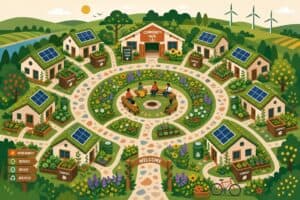
How Intentional Communities Handle Shared Energy Systems
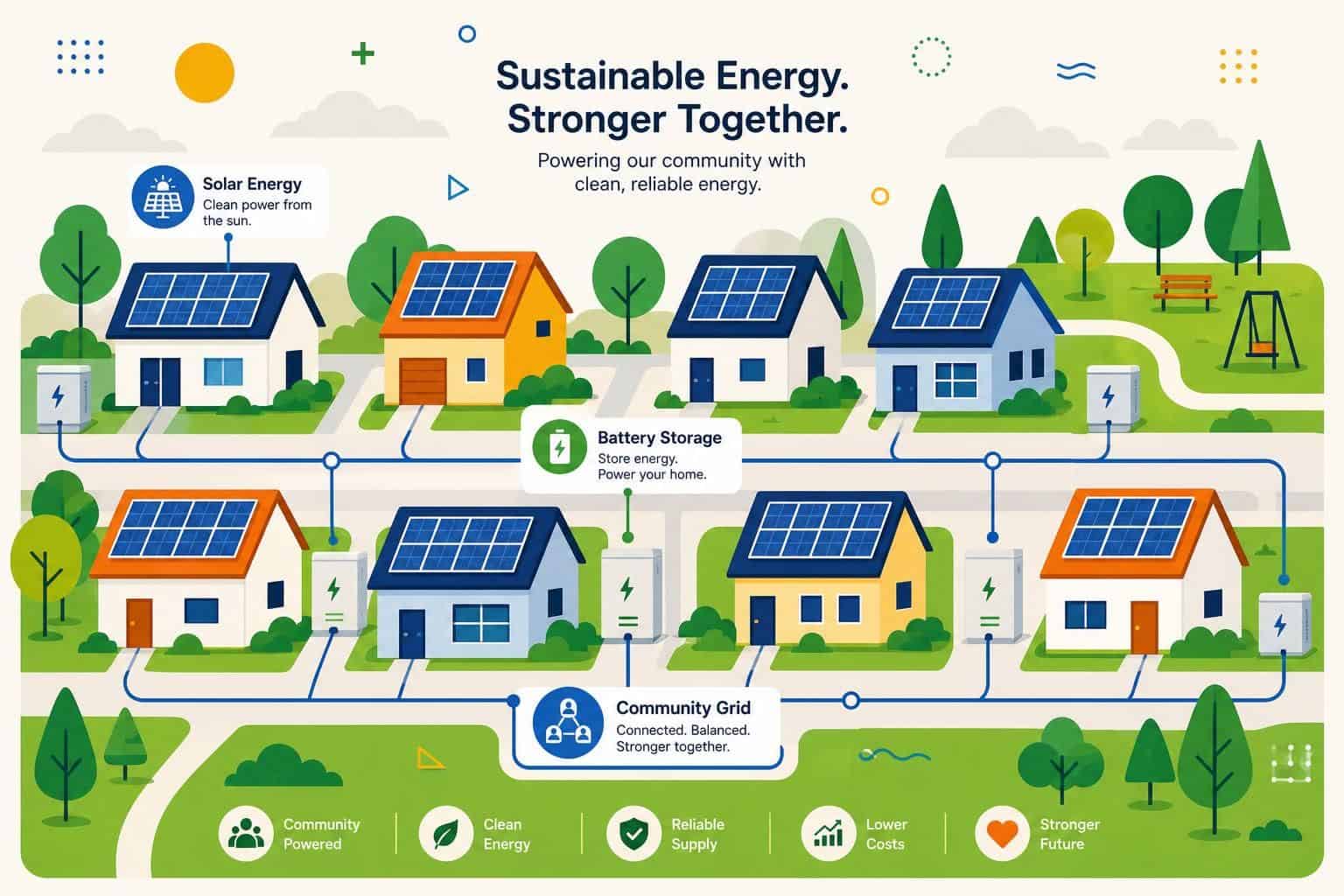 Shared energy systems in intentional communities offer a practical middle path between going it alone off-grid and staying permanently dependent on the utility grid. These setups combine solar panels, battery storage, and microgrids to power entire neighborhoods collectively — cutting both costs and carbon emissions in the process. This guide covers how real communities make shared energy work: the components involved, the tradeoffs, and the decisions that matter most before any hardware gets installed.
Key Takeaways
- Intentional communities can cut household energy costs by thirty to forty percent through pooled solar panels, battery storage, and microgrids that individual households cannot afford alone.
- Shared renewable systems can reduce carbon emissions significantly within the first year while delivering meaningful independence from traditional power grids.
- Microgrids, solar arrays, and district heating networks typically cost $5,000 to $15,000 per household upfront, with long-term savings driven by bulk purchasing and shared maintenance.
- Communities should match their energy setup to population size, local regulations, and available resources before selecting technology — not the other way around.
- Established communities like Earthaven Ecovillage and Twin Oaks Community demonstrate that collaborative energy management builds both resilience and stronger social bonds among residents.
What Are Shared Energy Systems in Intentional Communities?
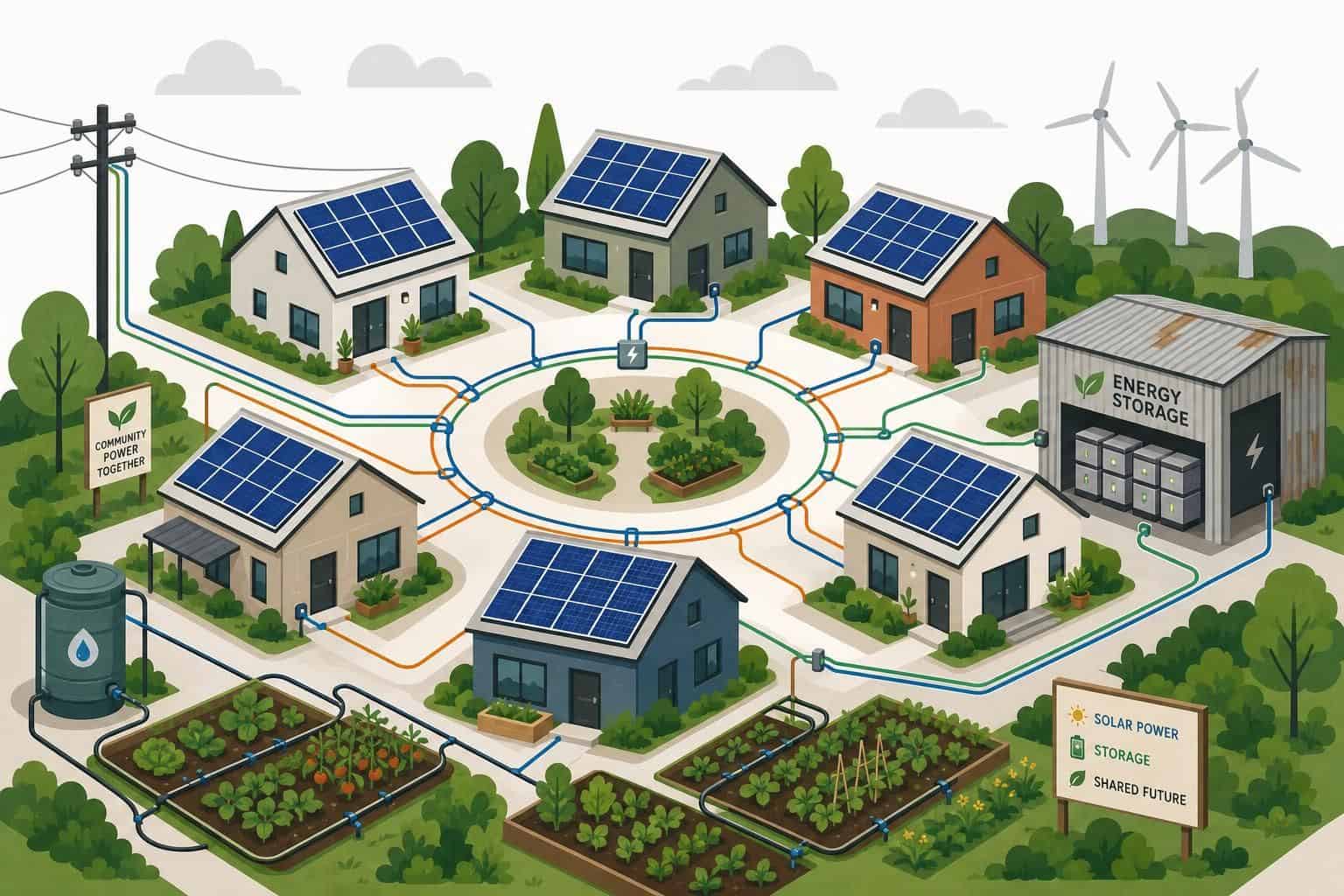 Intentional communities pool resources to create shared energy systems that power homes, gardens, and common spaces together. These interconnected networks let residents tap into renewable energy sources like solar power while reducing individual costs and environmental impact.
Definition and Purpose
Shared energy systems are collaborative infrastructure that residents design, build, and manage collectively. Rather than each home operating independently, community members draw from pooled renewable sources — solar panels, microgrids, and battery storage form the foundation. Communities like Earthaven Ecovillage in Western North Carolina and Dancing Rabbit Ecovillage in Missouri demonstrate how shared infrastructure strengthens both sustainability and social bonds. The purpose runs deeper than cutting electricity bills. Shared energy systems embody the lifestyle choices that define intentional communities and ecovillages. Members commit to environmental stewardship by pooling resources for renewable technology that no single household could afford alone. This cooperative model reinforces community governance: residents discuss energy needs, maintenance duties, and resource allocation together. Off-grid communities particularly benefit from this approach. Shared systems provide reliability and resilience in remote locations, helping residents achieve ecological goals while making sustainable living practical rather than aspirational.
Key Components: Microgrids, Solar Panels, and Battery Storage
Microgrids form the backbone of intentional communities seeking energy independence. These modular systems integrate solar panels, battery storage, and intelligent energy management into a single network operating at neighborhood scale. Companies like Enphase Energy and Blue Planet Energy manufacture components that communities combine to build resilient power systems. Unlike traditional grids, microgrids can disconnect and operate independently when needed. Solar panels capture sunlight and convert it directly into electricity. Battery storage holds that power for cloudy days or nighttime hours. Off-grid living becomes practical when residents layer these three components together. Ecovillages and cohousing communities like Heartwood Cohousing Community and Rachel Carson Ecovillage have deployed such systems successfully. The Living Energy Farm in Virginia powers its intentional community on just 200 to 250 watts of solar capacity per person using a Direct Drive DC Microgrid, which eliminates the need for expensive inverters. This approach can reduce battery capacity requirements to roughly two percent of a conventional AC system by running heavy appliances strictly on “daylight drive” when the sun is shining — a proven, low-cost alternative that helps communities avoid massive upfront battery expenditures. Advanced energy management systems orchestrate how power flows through interconnected microgrids, monitoring demand in real time and directing electricity where it is needed most. Dandelion Energy brings geothermal heating and cooling into the mix, reducing electricity consumption for temperature control. Hydroelectric micro-generation supplements solar production in locations with flowing streams, and small wind turbines capture wind energy where geography permits. Battery storage acts as the system’s financial buffer — capturing excess solar production and releasing it during peak demand hours. Residents in communities practicing permaculture and sustainable living find that shared energy infrastructure aligns naturally with their values of collective stewardship.
Benefits of Shared Energy Systems
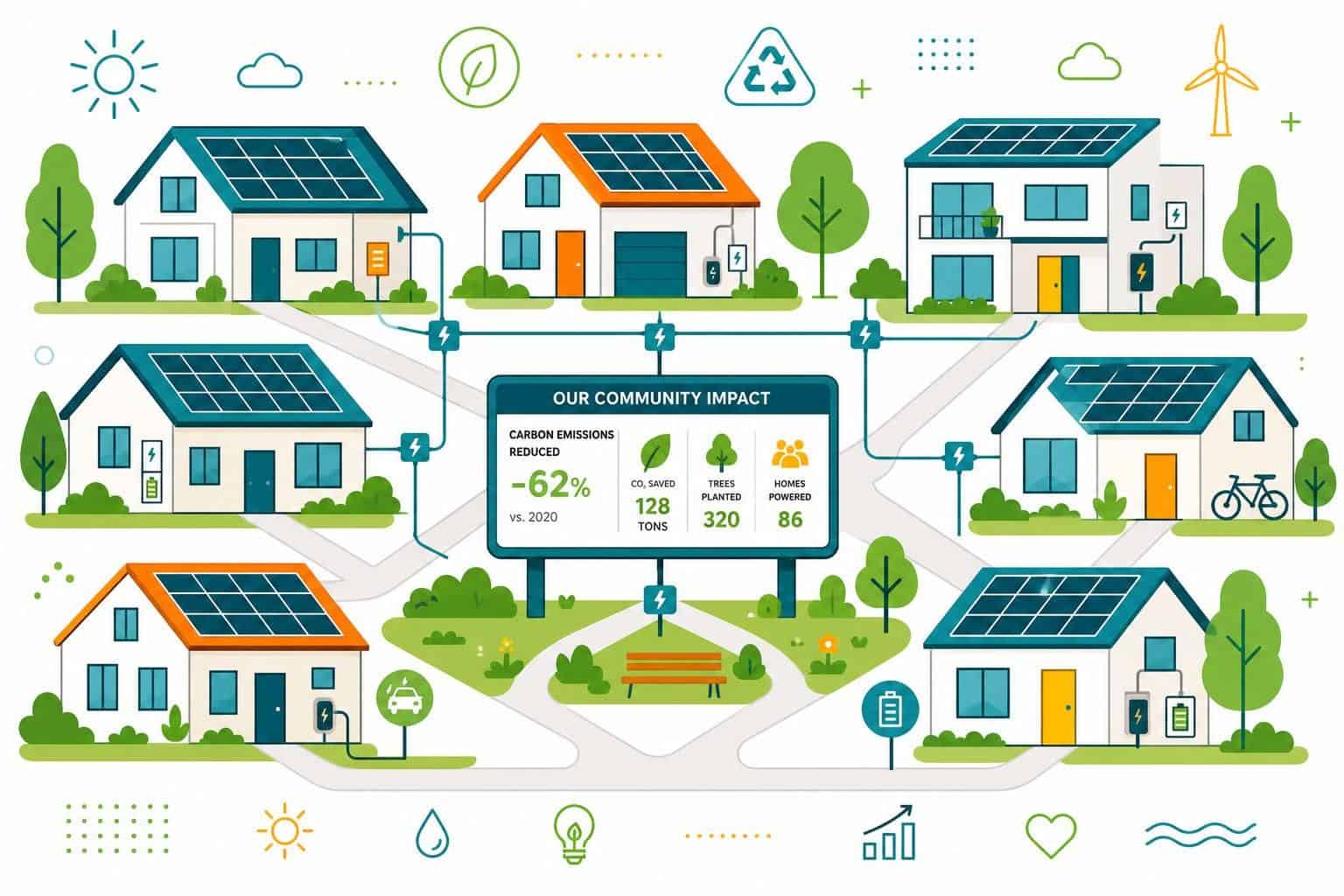 Shared energy systems deliver measurable environmental and financial benefits. Communities reduce carbon emissions substantially while members keep more money in their pockets.
Reduced Carbon Footprints
Intentional communities reduce carbon emissions significantly by switching to renewable energy systems. Solar panels, wind turbines, and hydroelectric generators replace fossil fuels, and battery storage captures energy during peak production hours for use after sunset or when wind drops. This eliminates the need for grid electricity generated by coal or natural gas plants. Residents at ecovillages such as Living Well Ecovillage and Emerald Earth report cutting household emissions in half within the first year. One small mountain cohousing cluster ran a month-long trial before committing to full investment. Twelve households tested an 18-kilowatt shared solar array paired with a 60-kilowatt-hour battery bank. The trial delivered a 38 percent average energy cost reduction across all households. Common spaces received an average of 4.2 kilowatt-hours per household daily, and the battery system held through a 16-hour simulated outage without interrupting essential loads. Immediate bill relief and overnight battery performance were enough to convince members to greenlight phased installation — a useful reminder that trial periods help communities validate performance claims before committing capital. Regenerative agriculture and permaculture practices add further carbon benefits. Polyculture food forests and perennial crops sequester carbon directly in soil and plant matter, transforming landscapes into carbon sinks. Integrated pest management replaces chemical sprays with natural solutions, protecting local ecosystems while reducing manufacturing emissions tied to pesticide production. Rainwater collection and greywater recycling decrease fresh water demand, cutting the energy required for treatment and distribution. Communities practicing these methods at locations like Sahale Learning Center and Konohana Family demonstrate that well-designed intentional communities can function as carbon-negative systems.
Energy Independence and Reliability
Communities that embrace shared energy systems gain the ability to operate independently from the traditional electrical grid. Solar microgrids with battery storage capture excess energy during daylight and release it after sunset. Wind energy systems stabilize generation where sunlight varies seasonally, and hydroelectric micro-generation supplies reliable power independent of weather — making it well-suited to properties near flowing water. These layered approaches create a safety net that protects residents from grid failures and rolling blackouts. A late 2025 report on climate resilience in off-grid communities found that communities using diversified solar photovoltaic systems combined with intelligent load management experienced an 87 percent reduction in climate-related power outages compared to grid-dependent counterparts. Geothermal systems provide heating and cooling with minimal grid dependence, reducing strain on shared infrastructure. Atmospheric water generators and solar-pumped wells contribute to off-grid water independence alongside energy solutions. Community-managed systems foster local skill development and reduce reliance on outside support. Residents at places like Terra Futura Regenerative Neighborhood and Westwood Cohousing Community learn to troubleshoot problems themselves rather than waiting on distant utility companies — a shift that transforms residents into active stewards of their own power supply.
Lower Operational Costs for Communities
Intentional communities reduce energy bills through bulk purchasing power and shared infrastructure. When residents pool resources for solar panels, battery storage, and microgrids, manufacturers offer volume discounts that individual households cannot access. Clustered housing designs reduce the miles of wiring, piping, and roads that must be installed and maintained — a community of fifty homes needs far less infrastructure than fifty scattered properties. Phased development strategies allow communities to spread costs across multiple years, preventing financial strain during startup. Grant funding and social finance organizations provide favorable loans specifically designed for sustainable projects. Energy monitoring systems and efficient design work together to minimize consumption across the entire community. Internal economies — local currencies or bartering systems — keep money circulating within the community rather than flowing to outside vendors. The Fellowship for Intentional Community and organizations supporting cooperatives have documented that residents in well-designed communities spend thirty to forty percent less on utilities and transportation combined compared to suburban counterparts.
Practical Examples of Shared Energy Systems
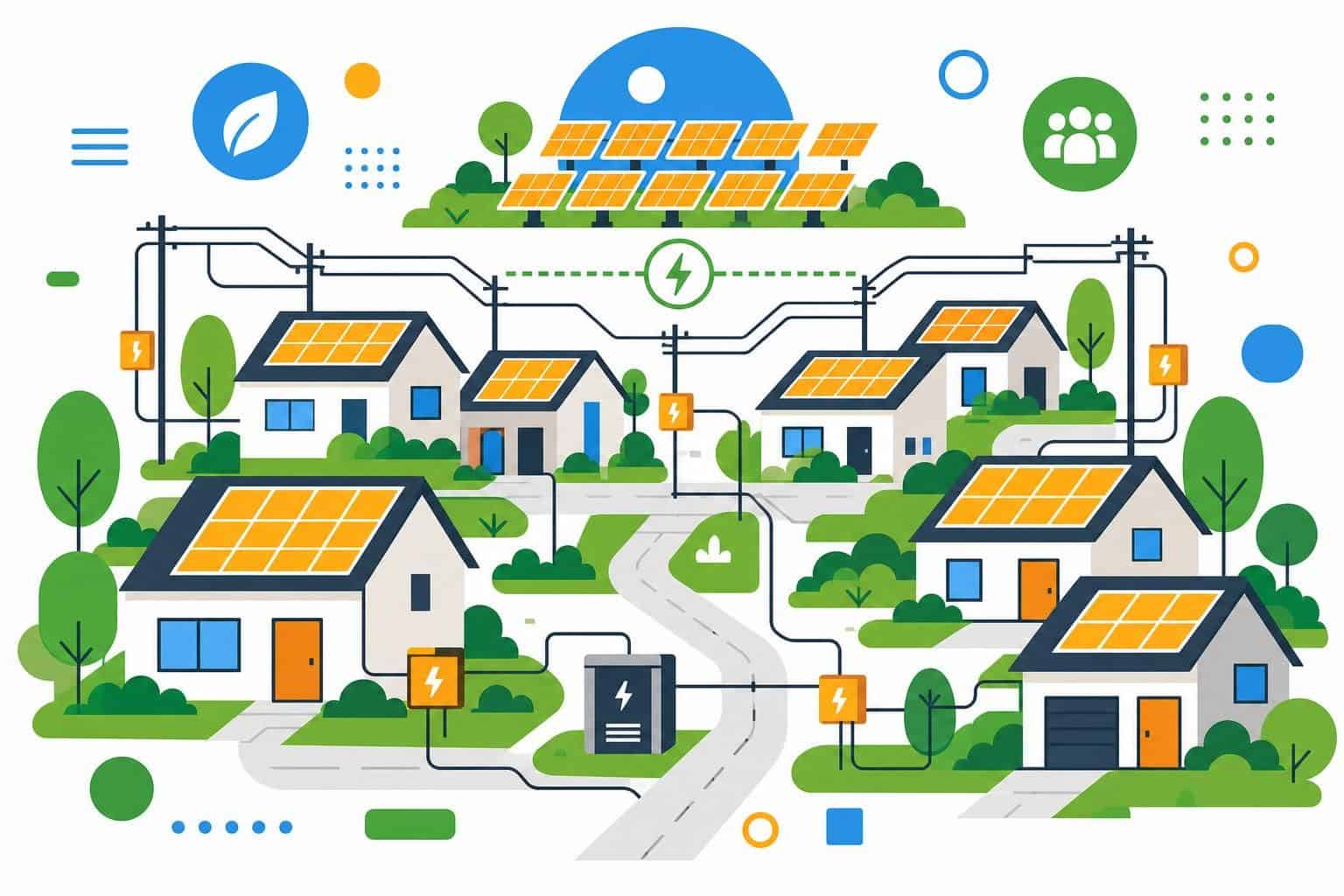 Real communities across the country have put shared energy systems to work. These installations range from small neighborhood solar arrays to large district heating networks serving hundreds of households.
Community Solar Projects
Community solar projects distribute clean energy across multiple households by pooling resources into shared solar arrays. Residents in intentional communities benefit from reduced infrastructure costs, splitting installation and maintenance expenses among many families. Companies like Blue Planet Energy and Enphase Energy provide the microgrids and battery storage components that make these arrangements possible. Participants receive credits on their energy bills based on their share of solar production, creating a transparent and equitable system. Educational workshops accompany many projects, building resident expertise in renewable energy and fostering collective responsibility. One small valley eco-hamlet switched from individual rooftop panels to a shared community array with centralized battery storage and collective billing credits. Before the transition, households drew an average of 420 kilowatt-hours monthly from the grid at $135 per household. After nine months of operation, grid draw dropped to 260 kilowatt-hours per household and average bills fell to $84. The community measured an estimated annual carbon reduction of 1.6 metric tons of CO₂ equivalent per household, and centralized maintenance reduced logged repair hours by 28 percent compared to the previous individual setup. Centralizing the array cut paperwork and unplanned repair calls substantially — residents now trade labor credits rather than calling contractors for every inverter issue. Shared solar arrays store excess energy in batteries for use during peak demand hours or overnight, eliminating the need to draw from the grid. This approach reduces environmental impact while supporting local food systems and community-building initiatives. Property owners and off-grid enthusiasts find that community solar arrangements offer reliability without complete isolation — proof that sustainable homes do not require individual sacrifice, but reward collective action.
District Heating Networks
District heating networks share thermal energy across multiple homes in compact neighborhoods, pumping hot water or steam through underground pipes to residential and commercial buildings. Residents in walkable areas benefit most because shorter distances mean less energy loss during transport. Decentralized heating systems can reduce energy consumption by up to 30 percent compared to individual furnaces. Local heating networks often tap renewable sources like solar thermal collectors or biomass fuel. Intentional communities and ecovillages implement these networks to lower operational costs while cutting carbon footprints. Energy audits before installation help stakeholders understand actual demand and size systems appropriately. Off-grid properties and rural destinations find district heating particularly valuable during harsh winters. Machine learning now optimizes energy distribution in these systems, making them more responsive to demand fluctuations. Implementation requires careful planning and strong community engagement from the outset — residents must agree on shared infrastructure costs and maintenance responsibilities before the first pipe goes in the ground. Public-private partnerships often help overcome regulatory barriers that block smaller projects. West Asheville and other intentional communities demonstrate how district heating works in practice, and operations like Living Web Farms show that thermal networks can support both food production and comfortable living spaces. Initial investment is substantial, but long-term savings accumulate steadily for participating households.
Interconnected Microgrids
Interconnected microgrids form the backbone of modern off-grid communities seeking energy resilience. Multiple microgrids operate together through advanced energy management systems that coordinate power flow seamlessly. Each microgrid can function independently when needed, yet they support one another during peak demand or equipment failure — a dual capability that centralized grids cannot match. Communities like those profiled at intentional community survival networks have adopted this approach to achieve genuine energy independence. Operators can shift power between microgrids in seconds, preventing blackouts and waste. Community-scale microgrids also enable flexible growth as populations expand and energy demands increase. Germany and Denmark have demonstrated successful interconnected microgrid communities that serve as practical models for North American eco communities. These systems achieve economies of scale in both installation and operation, reducing per-household costs significantly. A community of fifty households can start with one microgrid, then add another as membership grows — advanced energy management systems handle the coordination automatically. Researchers and off-grid destination readers frequently ask about scalability; interconnected microgrids answer that question directly.
Decision Criteria for Choosing Shared Energy Systems
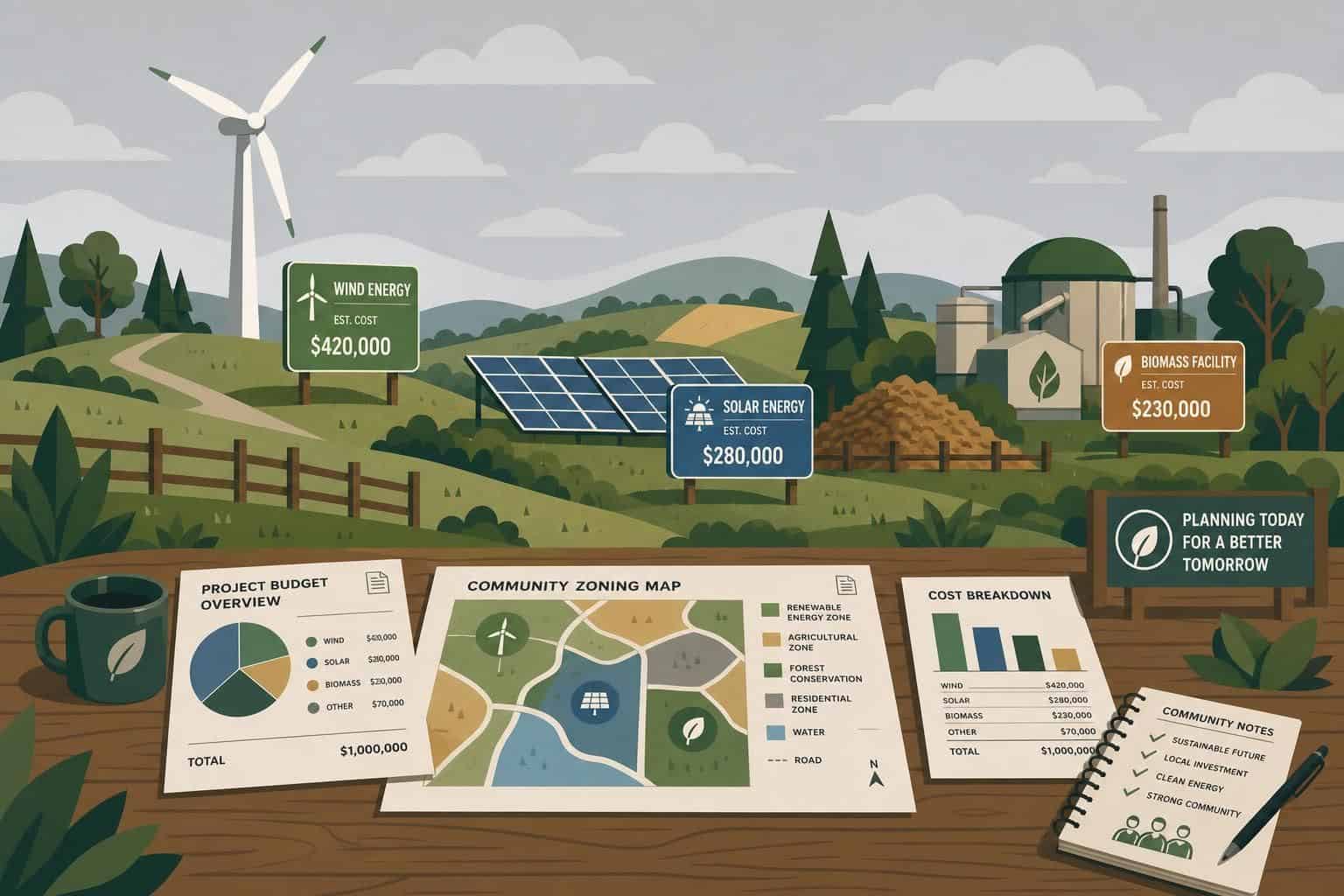 Communities should match their energy systems to what they actually need, what they can afford, and what their local regulations permit.
Energy Needs and Community Size
Sizing a shared energy system starts with honest math about who lives there and what they actually use. A small homestead with five households needs far less solar capacity than a settlement housing dozens of residents. Larger communities realize greater economies of scale in energy generation, spreading costs across more households and reducing the per-unit price. Housing cooperatives in Germany and Denmark have proven this principle works across different climates and cultures. Residents should evaluate energy needs before selecting technology — not the other way around. This prevents expensive oversizing or frustrating shortfalls when winter arrives or summer heat spikes demand. One rural microgrid planning group used a straightforward decision framework to choose between a single community microgrid and two interconnected smaller microgrids. Working from 28 current households, projected growth of five households per year, and a peak per-household load of 3.5 kilowatts, the committee calculated initial capacity at 120 percent of current peak demand. The analysis favored splitting capacity into two 40-kilowatt microgrids rather than installing one 80-kilowatt centralized system. This modular approach lowered projected per-household capital by 12 percent while allowing staged growth and cross-support between units — and reduced the risk of a single point of failure. Successful intentional communities treat energy citizenship as an active practice, not a passive utility bill. Residents should understand their consumption patterns and participate in decisions about capacity. Small communities might operate a single battery storage system; larger settlements need multiple interconnected microgrids to handle peak loads. Decision-making processes must address both individual household requirements and collective infrastructure demands.
Budget and Maintenance Requirements
Shared energy systems require upfront capital that communities can raise through multiple channels: direct resident investment, crowdfunding, and social finance loans with flexible repayment terms tailored to collective budgets. The cost per household varies based on system size, technology choices, and community structure. A small solar microgrid might cost $5,000 to $15,000 per household, while larger district heating networks run higher. Phased development strategies help communities spread expenses across several years, and grant funding from environmental organizations and government programs can reduce financial barriers significantly. Under current US tax policy, the Inflation Reduction Act allows tax-exempt intentional communities and nonprofits to use a “Direct Pay” provision to claim the Section 48 Investment Tax Credit — a base rate of 30 percent, stackable up to 70 percent with bonuses for low-income or energy communities — as a direct cash refund. This provides a concrete federal mechanism for lowering the capital barrier beyond generic grant advice. Communities should verify current IRA provisions with a qualified tax advisor, as policy details may change. Maintenance of shared systems requires collective responsibility and skill sharing. Communities like Twin Oaks Community use income-sharing or labor credit systems to fund ongoing upkeep without draining individual budgets. Bulk purchasing of replacement parts cuts costs substantially compared to individual retail purchases. Maintenance needs should match community skills to avoid dependence on external contractors at premium rates. Residents who develop technical expertise become valuable assets — training others and catching problems before they become expensive repairs. Preventive maintenance schedules, tracked collectively, keep systems running smoothly and extend infrastructure lifespans considerably.
Local Regulations and Incentives
Shared energy systems operate within a complex web of local rules and financial incentives that can make or break a community project. Municipal and state governments offer tax credits, rebates, and performance incentives for solar installations, wind turbines, and energy efficiency upgrades. Communities should research their specific jurisdiction to identify available grants from sustainability-focused foundations, which often support innovative renewable energy projects. Regulatory frameworks shape whether interconnected microgrids and district heating networks can function legally in a given area. Some regions impose barriers through outdated codes. The California Energy Commission’s BEAT pilot project illustrates the risk: the Berkeley Energy Assurance Transformation pilot had to abandon its plan for a fully grid-isolated, islandable microgrid because local utility tariff requirements made it financially unworkable. The project shifted from a fully off-grid plan to a grid-tied setup — a useful reminder that regulatory constraints can force a complete pivot in energy strategy, regardless of technical readiness. Other regions provide streamlined permitting processes that accelerate implementation. Public-private partnerships facilitate system deployment, especially for district heating applications where municipalities collaborate with private developers to share infrastructure costs and expertise. Legal structures matter when communities pool resources for shared infrastructure. Community land trusts protect collective ownership and maintain affordability by holding title to the property while residents control operations. Residents should consult local planning departments early in project development to understand zoning requirements, interconnection standards, and any renewable energy mandates that apply to their area.
Off-Grid Living and Shared Energy Systems
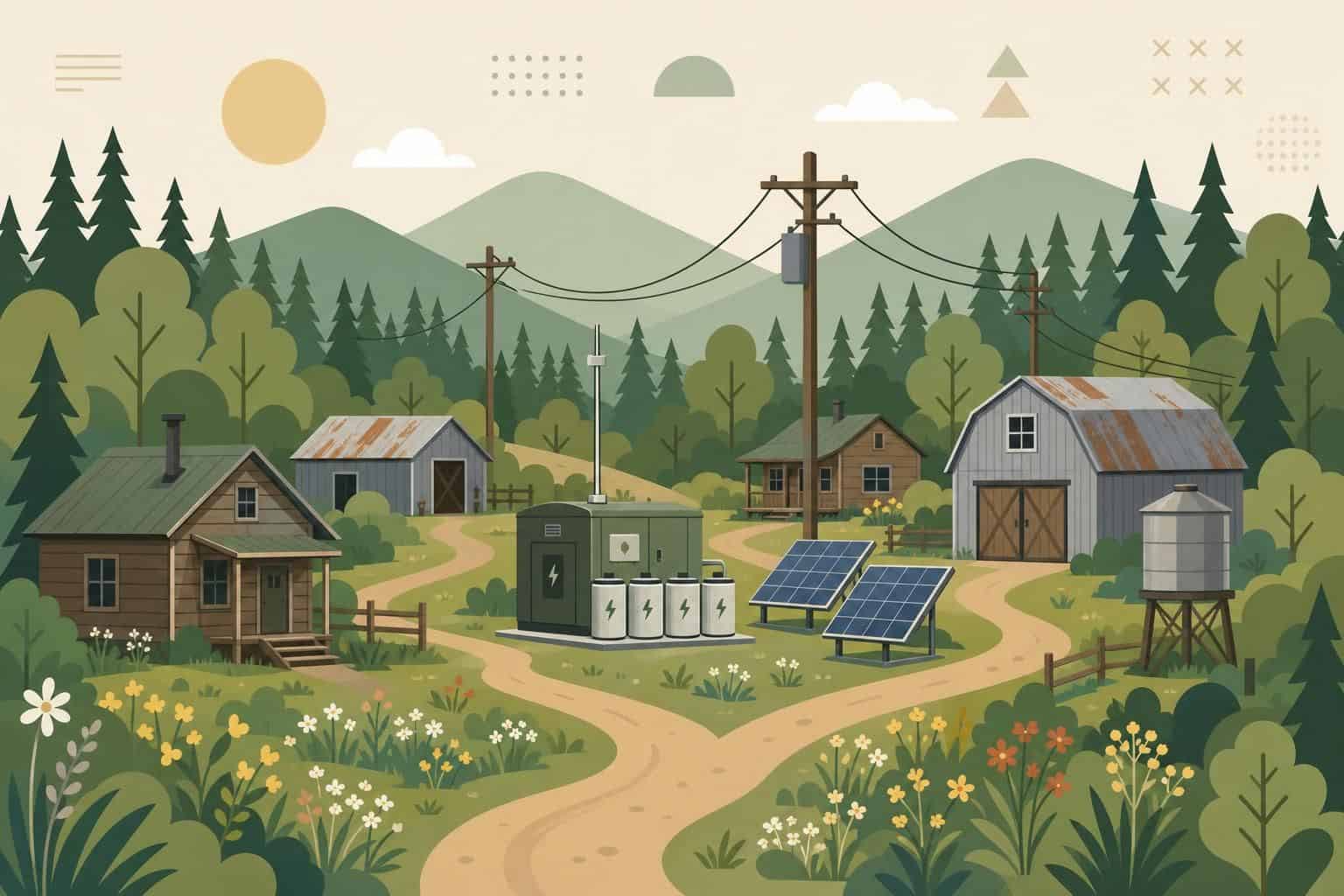 Off-grid communities thrive when residents pool their energy resources through shared systems that reduce waste and improve reliability. Remote properties and eco homes benefit from interconnected microgrids, battery storage networks, and solar arrays that members operate together.
Applications in Remote Properties and Eco Homes
Remote properties and eco homes are well-suited to shared energy systems designed for isolation and self-reliance. Solar panels paired with battery storage create the backbone of these installations, allowing households to generate and store power without grid connections. Modular microgrid systems deploy rapidly across dispersed properties, connecting multiple homes through intelligent energy distribution networks. Wind turbines and hydroelectric generators supplement solar production in areas with consistent wind or flowing water. Geothermal systems provide heating and cooling efficiency that passive solar design and efficient insulation amplify throughout the year. These technologies work together to eliminate dependency on centralized power infrastructure, giving residents genuine control over their energy supply. Solar-pumped wells paired with battery storage ensure consistent water and power access in locations where municipal services never reach. Vertical farming and shipping container farms feed residents year-round while consuming minimal energy through efficient design. Waterless sanitation and composting systems eliminate sewage infrastructure needs, completing the self-sufficient picture that draws people toward off-grid living. Hosts managing guest stays on remote properties find that transparent energy management builds trust with visitors who value sustainability — and that shared systems transform individual maintenance burdens into collaborative responsibilities.
Usefulness for Hosts, Guests, and Owners of Off-Grid Stays
Shared energy systems make off-grid hospitality operations more reliable and commercially viable. Hosts and property owners benefit from bulk purchasing power that reduces operational costs, while battery storage and microgrids keep the lights on during grid outages or extreme weather — protecting guest comfort and business continuity. Biogas generators convert organic waste into cooking gas and fertilizer, creating closed-loop systems that reduce expenses while supporting on-site agriculture. Educational workshops attract visitors interested in sustainable living and ecotourism, turning properties into learning destinations. Guests experience tangible benefits beyond novelty: consistent power, hot water, and reliable appliances without compromising the off-grid character of the stay. Water harvesting and filtration systems provide potable water for daily use, eliminating concerns about supply interruptions. Collaboration among hosts and owners fosters innovation in off-grid solutions, meaning guests access current sustainability practices rather than outdated workarounds. The shared approach reduces individual maintenance burdens, allowing property owners to focus on hospitality rather than constant system troubleshooting.
Further Reading: Off Grid Destinations Journal
The Off Grid Destinations Journal offers practical guidance on implementing shared energy systems within intentional communities, covering renewable energy technologies, regulatory frameworks, and proven community practices. Case studies profile successful off-grid properties operating microgrids and battery storage networks, with insights from community founders on the challenges and realities of shared energy management. The journal tracks technological developments that make district heating networks and community solar projects more accessible to eco-conscious groups, and highlights international examples of communities that have achieved energy independence through collaborative approaches.
Community Case Studies: Intentional Community Survival
Real-world communities demonstrate how shared energy systems work in practice. Earthaven Ecovillage, established in 1994 across 329 acres, pioneered integrated microgrids that power homes and common spaces. The Farm in Tennessee, founded in 1971, operates interconnected solar infrastructure that residents manage collectively. Dancing Rabbit Ecovillage uses ecological covenants that guide energy decisions transparently. Twin Oaks Community employs a labor credit system, ensuring members contribute fairly to energy maintenance and upgrades. International examples strengthen this evidence further. Findhorn Foundation in Scotland and Auroville in India operate district heating networks and battery storage systems serving hundreds of residents, each adapting their energy approach to local climates and available resources. Residents at both locations report lower operational expenses and greater energy independence than they would achieve individually. The Intentional Community Survival resource profiles these settlements in detail, covering governance structures, economic models, and infrastructure choices. Communities that invested early in shared systems now benefit from proven technologies and collaborative problem-solving methods that other groups can replicate.
Frequently Asked Questions
How much does a shared energy system cost per household?
A small solar microgrid serving ten households typically costs $5,000 to $15,000 per household before incentives. Larger systems in communities of fifty or more members often drop to $3,000 to $8,000 per household through bulk purchasing. Communities can spread costs across multiple years using phased development, and grant funding combined with social finance loans can offset 30 to 50 percent of installation costs.
Can shared systems work in extreme climates?
Yes, but communities must plan for backup systems. During the 2022 energy crisis, Polish housing cooperatives adapted by combining solar with coal and wood backup heating. Battery storage requires careful planning in extreme temperatures because weather swings strain equipment. Successful communities layer multiple energy sources and maintain redundant low-tech alternatives.
What is the lifespan of shared energy infrastructure?
Modern modular systems like BOXPOWER and solar microgrids typically last 25 to 30 years with proper maintenance. Solar panels often carry 25-year warranties, while battery systems generally need replacement every 10 to 15 years. Communities that schedule regular upgrades and track performance data extend operational life significantly. Preventive maintenance matters more than the initial technology choice.
What are shared energy systems in intentional communities?
Shared energy systems let community members pool resources to generate and distribute power together, typically using solar panels, wind turbines, or micro-hydro setups. According to the National Renewable Energy Laboratory, shared solar installations can reduce electricity costs by 20 to 30 percent compared to individual household systems.
How do communities split energy costs fairly?
Some communities divide bills equally among all members, while others track individual usage with separate meters and charge based on consumption.
Who maintains the solar panels and other equipment?
Many communities rotate maintenance duties among trained residents, while others hire professional technicians for complex repairs. Solar panels typically require only 2 to 4 hours of basic cleaning and inspection annually, making resident-led maintenance feasible for most groups.
What happens when one household uses significantly more power than others?
Communities typically set usage guidelines upfront, often capping households at 500 to 800 kWh monthly based on total system capacity. Members who exceed limits usually pay tiered overage fees, with rates increasing by 10 to 20 percent above the baseline to encourage conservation — keeping costs fair while maintaining community harmony.
Conclusion
Shared energy systems represent more than a technical upgrade for intentional communities. Communities like Living Energy Farm and Sirius Community show that residents can generate their own power, reduce costs substantially, and build stronger bonds through collaborative decision-making. Microgrids, solar arrays, and battery storage work best when people commit to consensus-based governance and understand how their choices affect neighbors. Off-grid living becomes genuinely sustainable when communities pool resources, share maintenance duties, and embrace the learning curve together. Residents interested in this path should explore the Foundation for Intentional Community’s directory, review case studies from established ecovillages, and connect with communities that have already worked through the hard problems.
References
- ^https://www.mdpi.com/1996-1073/18/16/4410
- ^https://pmc.ncbi.nlm.nih.gov/articles/PMC10853260/
- ^https://www.researchgate.net/publication/399121824_Demand_and_storage_optimization_in_energy_communities
- ^https://mrvpd.org/wp-content/uploads/2018/08/SolarFarmProjectInformational.pdf
- ^https://www.mdpi.com/1996-1073/17/12/2936
- ^https://www.mdpi.com/2673-4826/6/4/73
- ^https://www.mdpi.com/1996-1073/17/15/3789
- ^https://thecommonsjournal.org/articles/10.5334/ijc.1476
- ^https://www.researchgate.net/publication/309452750_Renewable_energy_integration_into_community_energy_systems_A_case_study_of_new_urban_residential_development
- ^https://www.researchgate.net/publication/381292929_The_co-benefits_and_risks_of_smart_local_energy_systems_A_systematic_review
- ^https://www.mdpi.com/1996-1073/17/19/4848
- ^https://www.sciencedirect.com/science/article/pii/S2666188826001966
- ^https://www.researchgate.net/publication/399490759_Sustainable_Energy_Solutions_for_Off-Grid_Communities_A_Review
- ^https://www.sciencedirect.com/science/article/pii/S2214629625002816
- ^https://www.mdpi.com/2076-3417/15/19/10401
Off Grid Destinations note: For off-grid stays, cabins, and remote properties, the best choice is usually the one that fits the real site conditions: guest use, owner maintenance, access, weather, storage, backup systems, and long-term reliability. Bigger or more expensive is not always better. The right setup is the one that works consistently without creating unnecessary upkeep.